
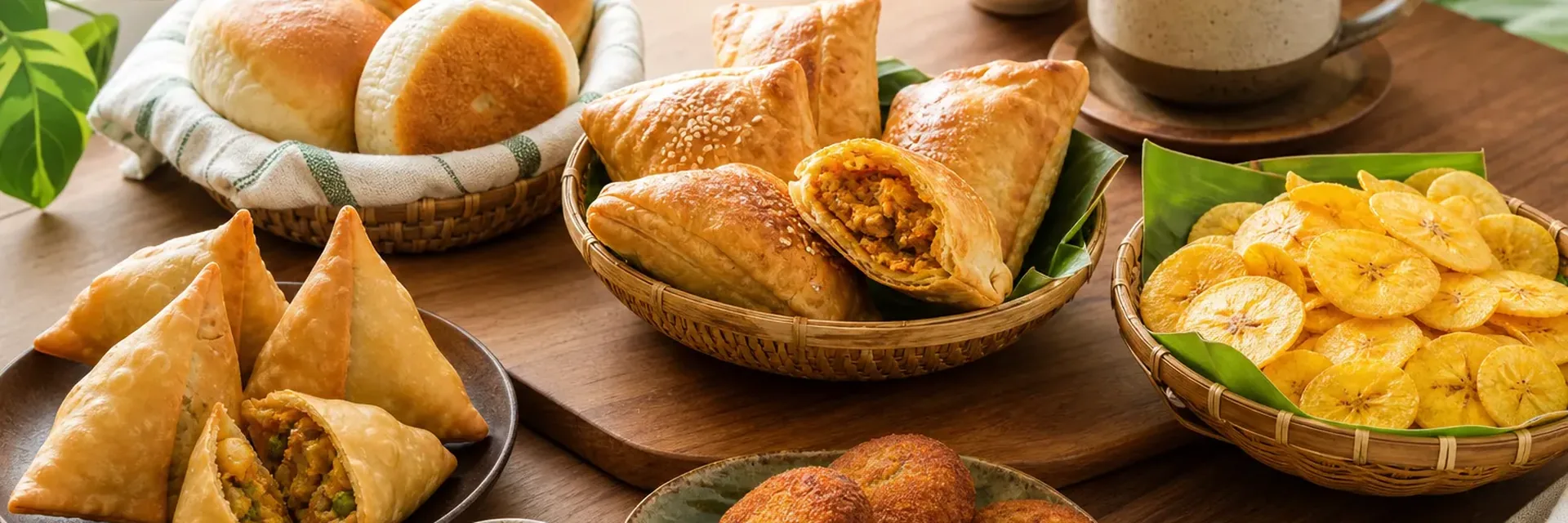
There is a smell that every Keralite knows. It hits you before you even open the bakery door: warm pastry, black pepper, caramelised onion, something spiced and golden coming straight out of the oven. On a rainy Trivandrum afternoon, that smell from a fresh chicken puff is as reliable as the rain itself. It is the kind of memory that does not fade.
If you have ever wondered what are popular Kerala savouries, start with the foods that show up every single day, chicken puffs, egg puffs, buns, cutlets, samosas, and banana chips. These are not simply snacks. They are part of the daily rhythm here. A bun tucked into a school bag. A cutlet eaten standing at a bakery counter during the lunch break. A samosa wrapped in paper, still warm, carried onto the train at Thiruvananthapuram Central. These foods appear at birthday parties, hospital waiting rooms, church gatherings, and late-night arrivals when nothing else is open. They belong to ordinary days as much as they belong to celebrations.
This guide covers the savouries that matter most in Kerala bakery culture: chicken puffs, egg puffs, buns, cutlets, samosas, banana chips, and the wider dry snack shelf. By the end, you will know what makes each one worth seeking out, when it is eaten, and what separates a genuinely good one from a forgettable one. Trivandrum bakeries like Bread Factory keep these traditions alive by baking fresh in-house every single day, and that discipline is worth understanding.
The beloved puff: why chicken and egg puffs rule Kerala bakeries
What makes a Kerala chicken puff worth remembering
The Kerala chicken puff has a very specific character. The pastry shell is flaky in a way that collapses the moment you bite into it, leaving buttery layers on your fingers. Inside sits a spiced chicken filling seasoned with black pepper, curry leaves, green chillies, and soft caramelised onion. That combination of textures and flavours is what makes it impossible to eat just one.
Its roots lie in the Anglo-Indian bakery tradition that arrived in Kerala through British colonial contact. The first Western-style bakeries in Cochin date to the mid-1800s, and the puff pastry technique gradually fused with local spice preferences to produce what is now a distinctly Kerala product. By the 1980s and 1990s, the chicken puff was a fixture at every neighbourhood bakery in the state, from Thiruvananthapuram to Thrissur. For a recent look at how Kerala bakeries evolved and the foods they popularised, see coverage of Kerala bakeries in the press, which charts both traditional items and newer trends: Kerala bakeries.
It turns up everywhere: school tiffin boxes, office tea breaks, train platforms, post-hospital stops, and after-school hunger moments that no proper meal can quite satisfy. It is eaten fast, while it is still hot, often without a plate.
The egg puff: humble, filling, and deeply satisfying
The egg puff, or motta puff as it is called locally, takes the same flaky pastry shell and fills it with a whole boiled egg nestled in spiced masala. It is a simpler construction than the chicken puff, but it earns its place through sheer reliability. It is economical, filling, and familiar in a way that feels immediate and uncomplicated.
Both puffs are at their absolute best when still warm. The pastry holds its flake for only a short window after it comes out of the oven. Once it cools and sits, the layers collapse into something softer and less satisfying. This is why bakery freshness is not a marketing point for puffs; it is simply the condition for them to be good at all. Bread Factory discusses the importance of choosing freshly baked bread and timely baking practices in more detail in What You Eat Every Day Matters: Why Choosing Freshly Baked Bread in Trivandrum Is Not a Small Decision, Bread Factory.
What are popular Kerala savouries beyond the puff, buns and soft-filled classics
The bun as an everyday Kerala tea-time snack
Kerala bakeries carry a whole range of buns: plain butter buns with a soft, yielding crust, sweet cream buns with a vanilla filling, and savoury stuffed buns packed with spiced vegetable or chicken. The bun sits in a useful space between a snack and a light meal. It is soft enough to eat quickly, filling enough to carry you through a few hours, and manageable enough to eat while standing or moving.
The chai-and-bun combination before work is a ritual that has existed for decades across Kerala. It is one of those small daily pleasures that is easy to overlook until it is gone. If you want a quick read on classic snacks that pair perfectly with evening tea, the Times of India has a pictorial feature on iconic Kerala snacks to pair with evening tea. The bun is not a dramatic food; it does its job quietly and consistently.
When a bun carries more than just filling
In Kerala households, the bun is often the first bakery savoury a child tries. It is also the go-to when a guest arrives unexpectedly and the reliable choice when nothing else feels right. Its quality depends almost entirely on three things: the dough, the freshness of the filling, and whether it was baked that day. A day-old bun is a different food from one that came out of the oven a few hours ago.
At Bread Factory, buns are baked fresh in-house daily across all Trivandrum outlets, which means when you pick one up, you are getting what a bun is supposed to be: soft, slightly warm, and made that same morning without shortcuts.
Cutlets and samosas: the crispy classics
The Kerala cutlet: spiced, crispy, and unmistakably local
The Kerala-style cutlet is shaped by hand, coated in breadcrumbs, and fried to a deep golden crust. Inside, the filling is typically spiced beef or vegetables, seasoned with garam masala, black pepper, turmeric, curry leaves, and green chillies cooked in coconut oil. The result is coarser and more robustly spiced than a standard croquette, and it is usually served with ketchup or a sharp green chutney.
Beef cutlets are a Travancore staple with a long history in the region’s Christian and Anglo-Indian communities. Vegetable cutlets appear at bakeries and snack stalls across the state, served to a wider audience. Both versions depend on the spice blend being done properly. A flat cutlet is almost always a problem of under-seasoning or stale filling.
The samosa: an adopted classic, fully Kerala
The samosa came to Kerala through North Indian influence and was quietly adapted to local preferences over decades. At Kerala bakeries, the samosa tends to be smaller and crispier than its North Indian counterpart, filled with spiced potatoes, onions, and green chillies, and sized for eating with a cup of tea rather than as a standalone snack.
Both cutlets and samosas share the same vulnerability: the crust softens quickly after frying. A samosa or cutlet that has been sitting under a glass dome for three hours is a shadow of what it was when fresh. The best ones are always found at bakeries with high turnover that restock throughout the day.
Banana chips and dry savouries: Kerala’s pantry favourites
Why Kerala banana chips deserve their own conversation
Kerala banana chips made from the Nendran variety are not the same as any other chip. The banana itself is starchier and denser than common varieties. When sliced thin and fried in fresh coconut oil, it produces a chip that snaps cleanly, absorbs minimal oil, and carries a naturally nutty-sweet flavour with just enough salt. No artificial colouring, no preservatives, no added flavouring, just three ingredients.
Good banana chips are a point of serious local pride. The quality of the oil matters (coconut oil, fresh, not reused), the thickness of the slice matters, and the Nendran variety itself is non-negotiable. These are not interchangeable details. They are what make Kerala banana chips genuinely different from any other chip you can buy. For a concise guide to popular Kerala snacks that highlights regional favourites, Pepperhub provides a helpful overview.
Banana chips occupy a larger cultural role than the word snack suggests. They are a gifting staple at festivals, a reliable travel companion on long train journeys, and a presence at every Onam and Vishu celebration spread. Pazham pori, batter-fried ripe banana, occupies a similarly beloved spot in the Kerala snack repertoire, though it belongs to a different register: warm, soft, and served fresh rather than stored. Banana chips belong to the dry shelf the way puffs belong to the warm counter.
Namkeen, mixture, and the dry savoury shelf
Alongside banana chips, Kerala bakeries and snack shops carry a range of dry savouries: spiced mixtures, murukku, ribbon pakoda (pakkavada), and roasted nuts. These fill a different role from fresh puffs and cutlets. They are made for sharing, storing, gifting, and snacking without occasion or preparation. A well-assembled Kerala savouries list for a festive hamper almost always includes a few of these dry items alongside the fresh bakes.
Pakkavada, ribbon-shaped and crispy, made from chickpea and rice flour, is a Kerala tea-time snack found at stalls across the state. Murukku appears at nearly every festive spread. The growing interest among Kerala families in reading ingredient labels has created demand for cleaner versions of these dry snacks: less artificial colour, fewer additives, simpler ingredient lists. That shift is worth paying attention to, and Malabar snacks, the dry savory traditions of northern Kerala, are also gaining wider recognition as part of this broader Kerala savouries list. Recent regional reporting highlights several northern Kerala snack traditions and the unique items they contribute to the wider culture, including Mutta Surka and chukka appam: Malabar snacks and North Kerala specialities.
Kerala savoury occasions: when each snack has its moment
The everyday snacking moments
The rhythm of savoury snacking in Kerala is built around specific moments rather than formal mealtimes. Morning tea with a bun before work. A puff tucked into the school bag for the mid-morning break. A cutlet and tea during the office lunch hour. A samosa on the way home when the evening hunger sets in. These are not festival foods. They are the quiet, consistent pleasures of an ordinary Kerala day.
The best bakeries understand this rhythm and bake accordingly, keeping the warm counter restocked throughout the day so that whenever someone arrives, there is something fresh waiting for them.
Savouries at festivals, visits, and celebrations
Banana chips, mixture, and dry savouries make their most prominent appearance at Onam and Vishu, where they sit alongside payasam and pickle as part of the customary welcome spread. They are also the default gifting choice when visiting a home during the festive season. A packet of good banana chips or a box of mixed Kerala snacks says something simple and honest about the effort behind the visit.
Puffs and cutlets appear in a different context: birthday parties, school events, church gatherings, and hospital visits. At these moments, food needs to be practical as well as comforting. A warm puff or a cutlet wrapped in paper carries both qualities without requiring explanation.
Where to find fresh savouries in Trivandrum: why freshness is everything
Why freshness changes the savoury experience completely
The difference between a fresh-baked puff and one that has been sitting for four hours is not subtle. The pastry loses its flake. The crust of a bun softens. The crispness of a cutlet fades. The aroma of the spiced filling dulls. What was excellent at 10 in the morning becomes average by 3 in the afternoon, not because anything went wrong, but because freshness is what these savouries are made of.
The best puff you have ever eaten was almost certainly still warm. That memory is not nostalgia. It is a simple fact about how these foods work. Freshness is not a premium feature reserved for high-end bakeries. It is what a savoury is supposed to be when it is made properly and served on time.
Bread Factory’s daily savoury bakes in Trivandrum
Bread Factory bakes its savouries fresh in-house every day across its Trivandrum outlets, including Vazhuthacaud, Kowdiar, Nalanchira, Sreekaryam, Kumarapuram, Medical College Road, and Overbridge. Chicken puffs, egg puffs, buns, cutlets, and more are made without preservatives and without shortcuts. The approach is straightforward: bake on the day, serve on the day, and never compromise on ingredients to extend shelf life.
This is what a responsible bakery should do. At Bread Factory, it is also a daily discipline maintained since the beginning. If you are in Trivandrum and want a puff or a bun made the way it should be, you will find it at any Bread Factory outlet across the city. You can also explore our full write-up on local offerings and evening favourites in Kerala bakery savouries: Evening snacks you crave in Kerala.
A final word on what are popular Kerala savouries
Popular Kerala savouries are not complicated food. They are honest, familiar, and deeply embedded in the daily life of the state. A chicken puff, a butter bun, a beef cutlet, a packet of Nendran banana chips, none of these need explanation. Every Keralite already knows what they are and when they want them.
What separates a good savoury from a great one is almost always the same thing: freshness, clean ingredients, and the care behind the bake. A flaky puff made properly that morning. A bun with a filling that was made fresh. Banana chips fried in coconut oil without cutting corners. These are not extraordinary standards. They are simply the right ones.
So if you were asking what are popular Kerala savouries and what makes them worth seeking out, the answer has always been the same: make them properly, serve them fresh, and do not overthink it. Kerala’s bakery culture has always understood this. The best bakeries still do.
If you want to order popular Kerala savouries, buns, puffs, cutlets, fresh bakes, and more, delivered directly to your doorstep in Trivandrum, download the Bread Factory app and browse everything we make fresh every day.
Download for Android on Google Play
Download for iOS on the Apple Store