
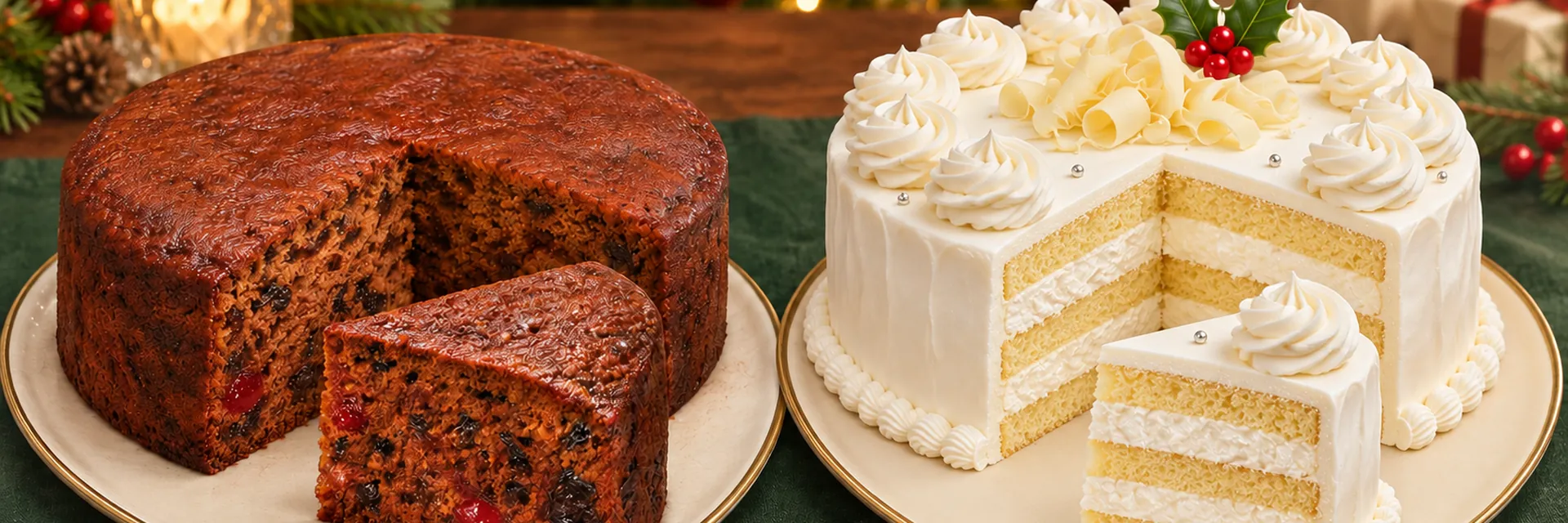
When people ask about plum cake vs Christmas cake in India, the answer is almost always the same: in Kerala, the two terms describe the same festive cake. Both refer to a dense, fruit-filled, spiced cake associated with the Christmas season. The two terms carry slightly different histories, though, and when you look closely at how fruit, spice, and maturation differ across styles, the distinction becomes real and worth understanding. At Bread Factory in Trivandrum, where the plum cake tradition is taken seriously, these differences shape three distinct cakes on the same shelf. This article explains what separates a plum cake from a Christmas cake, why Kerala has its own version of this story, and how to choose the right one for your table this December.
Key takeaways
- Same occasion, same cake: In Kerala, “plum cake” and “Christmas cake” are often used interchangeably, though individual shops may use each name for a particular style, darker and richly spiced versus lighter and butter-forward.
- No actual plums: The name “plum cake” comes from older British usage where “plum” loosely meant dried fruit, not the stone fruit.
- Kerala’s adaptation: The Indian plum cake tradition traces to Thalassery in 1883, where Mambally Bapu adapted an English recipe using local liquor and Malabar spices, giving it a distinct identity.
- Style matters: Dark, boldly spiced, and deeply fruited versus golden, buttery, and delicately spiced are the two broad style choices.
- Gifting is inclusive: Christmas cake gifting in Kerala extends across communities, making your choice of cake a gesture of thoughtfulness.
- Three choices at Bread Factory: The Matured Plum Cake, Golden Butter Plum Cake, and Rich Plum Cake each represent a distinct interpretation of this tradition.
Why plum cake has never actually had plums in it
The medieval English fruitcake that started it all
Plum cake did not originate in a kitchen with fresh plums. The name comes from older British usage, where “plum” was a loose term for dried fruit, particularly raisins and currants. What began as a spiced porridge eaten before Christmas gradually became a baked cake by the 16th century, once flour replaced oats and butter took the place of simpler fats. By the time British colonists carried the recipe abroad, “plum cake” was simply shorthand for a rich, dark, fruit-laden cake baked for Christmas.
This naming quirk matters because it explains why Indian bakeries sell plum cakes filled with raisins, dates, prunes, and candied peel, with not a fresh plum in sight. The name was always about occasion and tradition, not about one specific fruit. When you understand that, the difference between a “plum cake” and a “Christmas cake” starts to make more sense.
How the cake reached Kerala and became Indian
The decisive moment for India’s plum cake tradition is traced to Thalassery, Kerala, in 1883. A British planter named Murdoch Brown brought an English plum cake to Mambally Bapu at the Royal Biscuit Factory and asked him to replicate it. Bapu adapted the recipe to what was available locally: a fermented liquor made from cashew apples and bananas replaced French brandy, and Malabar spices, including cinnamon, cardamom, cloves, and nutmeg, took on a more central role than the original English flavourings allowed. The result was a cake that was British in structure but Keralite in character. That adaptation is the foundation on which every Kerala plum cake sold today is built.
The story is significant not just as history but as a baking philosophy. Bapu did not simply copy an imported recipe; he used what was around him and made something that belonged to his place. That instinct, to work with what is real and local rather than what is merely available, is exactly what thoughtful baking has always looked like in Kerala.
Plum cake vs Christmas cake in India: are they actually different things?
How the two terms are used today
In practice, most Indian bakeries and households use the two names interchangeably. Order a “Christmas cake” in Trivandrum and you will almost certainly receive a plum cake. The terms refer to the same occasion, the same general style, and more often than not, the same recipe. The word “Christmas cake” tends to emphasise the occasion; “plum cake” tends to emphasise the style. Neither term implies a strict recipe, and there is no culinary authority in India that separates them formally.
In Kerala, the bakery term of choice is almost always “plum cake.” You will find plain plum cake, rich plum cake, dry-fruit plum cake, and butter plum cake on most shelves from November onwards. “Christmas cake” appears more often in gift hampers and advertisements aimed at customers who recognise the broader English term. Both names describe the same Kerala tradition.
Where the distinction does matter
The difference becomes meaningful when you compare the British Christmas cake tradition to the Indian plum cake tradition. A traditional British Christmas cake is typically a very dense, alcohol-fed fruitcake baked weeks in advance and periodically brushed with spirits until Christmas Day. The Indian plum cake, as it evolved in Kerala, kept the dense crumb and dried fruit but became its own thing: more heavily spiced, less reliant on the alcohol-feeding ritual, and regularly adapted for households that prefer alcohol-free versions.
So “plum cake” in India can describe a broader range of styles than the strict British “Christmas cake” tradition suggests. A golden, buttery plum cake with mild spicing and bright fruit notes is still a plum cake. A very dark, intensely fruited double-matured cake is also a plum cake. Both can be called a Christmas cake. The names travel together, but the styles beneath them are genuinely different.
Fruit, spice, and maturation: what actually sets each style apart
The fruit mix and what it signals
A classic British-style Christmas cake leans on currants, raisins, sultanas, and candied citrus peel. The fruit is the dominant flavour, and the spice sits quietly behind it. An Indian-style plum cake often has a more assertive profile: dates, prunes, black raisins, cranberries, and sometimes candied cherries are common, with a heavier hand on Kerala’s own spices. This is what gives the characteristic dark colour and bold, warming quality to a good Kerala plum cake.
A golden or lighter plum cake works differently. It uses pale fruits, golden raisins, apricots, candied pineapple, and citrus peel, with milder spicing. The result is a crumb that is buttery and bright rather than deeply dark. The fruit mix is not just a flavour decision; it determines the colour, the texture, and the overall experience of the cake. Knowing what kind of fruit mix you are working with helps you choose the right cake for the right occasion.
How maturation shapes the final flavour
Maturation is what separates a genuinely good plum cake from a merely decent one. The fruit is soaked or matured before it enters the batter, allowing the flavours to meld and deepen. Traditional British Christmas cakes are also “fed” with alcohol after baking, pierced at intervals and moistened with rum or brandy over several weeks. Kerala-style plum cakes often follow a similar principle, though the alcohol-free version replaces rum with fresh fruit juices, honey, and citrus zest. The maturation period is what makes the cake complex rather than simply sweet.
Alcohol-free maturation has long been practised in Kerala and is now widely preferred by many households. Fresh orange juice, spiced fruit liquids, and honey can produce a cake that is just as deeply flavoured as an alcohol-matured version, provided the fruit is given enough time and the balance of ingredients is right.
How Kerala gave the plum cake its own identity
Local spices, a Malabar heritage, and a style that became distinctly Kerala
Kerala’s adaptation of the plum cake went beyond substituting one ingredient for another. Local spices, particularly cardamom, cloves, cinnamon, and nutmeg grown in the region’s own plantations, became central to the cake’s flavour rather than a background note. The spice character of a Kerala plum cake is distinct and recognisable. It is not aggressive, but it is present in a way that shapes every bite.
The preference for alcohol-free maturation also shaped the Kerala style in lasting ways. Using fruit juices, honey, and spice-infused liquids requires careful calibration: too much liquid and the fruit becomes wet and heavy; too little and the maturation is shallow. Getting it right demands the kind of attention to process that good baking has always required. This is not a shortcut; it is a different route to the same depth of flavour.
How Bread Factory in Trivandrum interprets this tradition
At Bread Factory, we approach the plum cake tradition with the same discipline that guides every product from the House of Azad since 1940. Our Matured Plum Cake is built around slow-matured fruits, bold Kerala spices, and a dark, moist, fruit-forward character. The Golden Butter Plum Cake takes a different path: controlled maturation, brighter fruits, and delicate spicing produce a lighter golden crumb that is distinctly buttery. The Rich Plum Cake goes further still, with double-matured fruits, a deeply dark colour, and an intensely moist texture.
No alcohol is used in any of our plum cakes. Each cake is made with real butter, never margarine. The three cakes sit on the same shelf but answer three entirely different ideas of what a Kerala plum cake can be. If you want bold and dark, the Rich Plum Cake is the answer. If you want warm and spiced but not overwhelming, the Matured Plum Cake is the place to start. If you want light, golden, and buttery, the Golden Butter Plum Cake is made for you.
Serving and gifting plum cake this Christmas in Kerala
What a Kerala Christmas table looks like
In Kerala households, the Christmas cake is not plated as a formal dessert. It is cut into slices for guests who come through the door after midnight Mass, served with strong tea or coffee, or laid out alongside a larger spread of regional sweets. Kulkuls, rose cookies, and sometimes dodol share the table with the plum cake. The cake is not the centrepiece of a dessert course; it is part of a broader gesture of festive welcome.
This is why the texture and intensity of the cake matters. A dense, well-matured slice holds its own next to spiced tea in a way that a light sponge would not. The cake needs to carry its own weight on a table that is already full of flavour. A well-made Kerala plum cake does exactly that, without demanding attention and without disappearing.
Choosing the right plum cake or Christmas cake in Trivandrum for gifting
Gifting Christmas cake in Kerala extends well beyond the Christian community. Neighbours, colleagues, and friends of different faiths are often included, making the choice of cake a small act of thoughtfulness. For gifting, a cake that reads clearly as festive and suits the recipient’s palate is ideal. A dark, richly spiced plum cake signals effort and tradition. A golden, buttery version suits households that prefer lighter flavours.
When you are ordering from a bakery rather than baking at home, the simplest approach is to know whether the recipient leans toward bold and dark or delicate and bright, then choose accordingly. If you are unsure, the Matured Plum Cake from Bread Factory sits comfortably in the middle: dark enough to feel festive, spiced enough to feel Kerala, and moist enough to serve generously on a full plate.
Plum cake vs Christmas cake in India: the choice that matters
Plum cake and Christmas cake are, for most practical purposes, the same thing in India. The difference lies in the style: how much spice, which fruits, how the maturation is handled, and whether the crumb is dark and dense or golden and buttery. Kerala did not simply adopt a British Christmas cake recipe. It reshaped it using local spices, regional baking instincts, and a preference for alcohol-free maturation that has remained consistent for generations.
That heritage is exactly what guides the three plum cakes at Bread Factory in Trivandrum. Whether you choose the Matured Plum Cake, the Golden Butter Plum Cake, or the Rich Plum Cake, you are choosing a version of a tradition that has been thoughtfully made, without shortcuts, since the House of Azad began baking in 1940. Proudly Kerala. Made for the World.
Browse the full Bread Factory range and have everything delivered fresh to your doorstep across Trivandrum through the Bread Factory app. The app is available for Android on Google Play and for iOS on the Apple App Store.
Download for Android on Google Play
Download for iOS on the Apple App Store