
You’ve had it happen before. A slice of chocolate cake from a good bakery in Trivandrum, and one you’ve baked at home using what seems like the same recipe. Both chocolatey. Both sweet. But one melts the moment it touches your tongue, leaving a richness that lingers cleanly. The other feels a little heavier, a little waxy, and somehow less satisfying. You follow the recipe exactly, so where does the difference come from?
More often than not, the answer is the fat. Specifically, whether the chocolate used in that cake contained real cocoa butter or a cheaper substitute. Cocoa butter is the natural fat found inside the cacao bean, also called cacao butter or cocoa fat, and it is the single ingredient responsible for chocolate’s signature melt, gloss, and depth of flavour. Many consumers encounter it in chocolate bakes repeatedly without ever knowing its name.
This article explains what cocoa butter actually is and why it matters in chocolate baking, how it differs from the fats commonly used in low-cost compound chocolates, how it controls the way chocolate bakes behave, and what to do when you need to substitute it at home. By the end, you will look at every chocolate pastry, cream cake, or cookie differently.
What is cocoa butter and why does it matter in chocolate baking?
Most people first encounter the phrase “cocoa butter” on a moisturiser label, not in a kitchen. But as a food fat, it has been central to chocolate making for centuries and is far more interesting than its skincare reputation suggests.
From cacao bean to pale yellow block
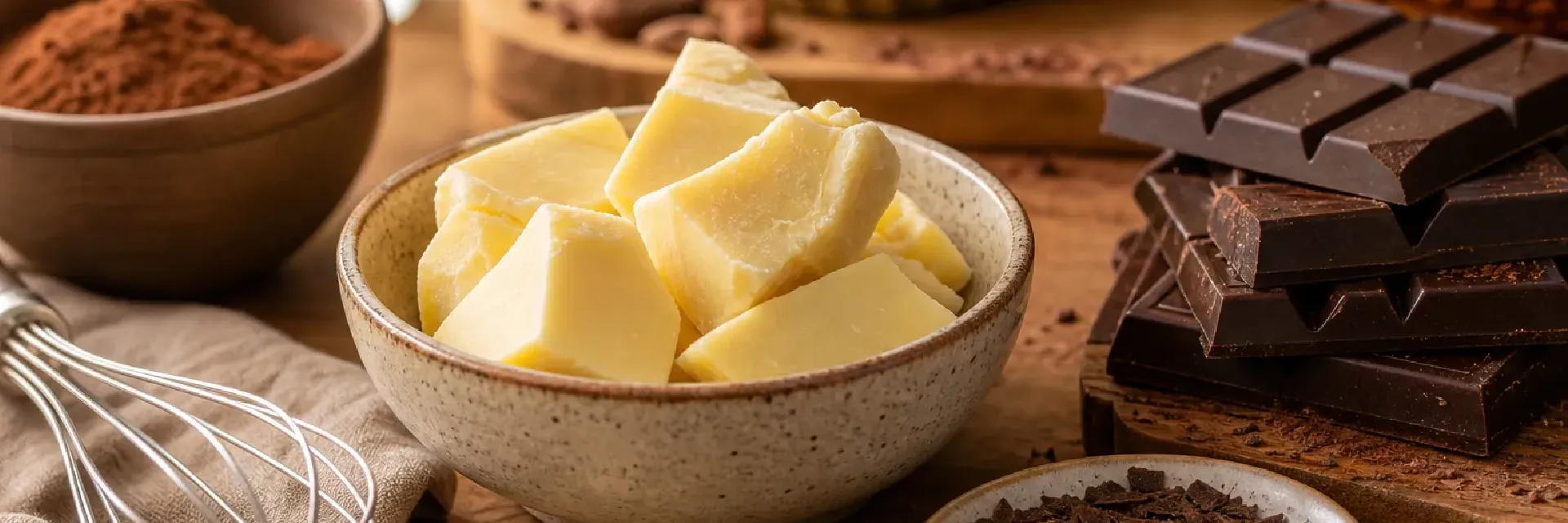
When cacao beans are roasted and pressed during processing, two things separate out: the fat, which is cocoa butter, and the dry solids, which become cocoa powder. Together, these two components form real chocolate. On its own, cocoa butter, sometimes listed as cacao butter or cocoa fat on ingredient labels, is a pale yellow, faintly chocolatey solid that melts smoothly between the fingers. It has a mild, clean aroma, nothing aggressive, and it sets firm at room temperature.
The fact that it comes from the same bean as cocoa powder sometimes confuses home bakers, but the two serve very different purposes. Cocoa powder brings colour and flavour. Cocoa butter brings fat, melt, texture, and gloss. Every good chocolate product you have ever tasted depended on both working together.
The melting point that makes chocolate special
Cocoa butter melts between 32 and 35 degrees Celsius, which is just below the temperature of the human tongue. This is not a coincidence. It is the reason chocolate feels the way it does. When good chocolate enters the mouth, it melts immediately and completely, releasing flavour in a clean, sudden rush rather than leaving a lingering or waxy film. Among commonly available food fats, cocoa butter’s narrow melting range and unique triglyceride composition make it exceptionally well-suited to this effect, which is why nothing truly replaces it in high-quality chocolate work.
Cocoa solids versus cocoa butter: two different things
Dark chocolate, milk chocolate, and white chocolate each contain different ratios of cocoa solids to cocoa butter, which is why they behave so differently when baked. Dark chocolate has the most cocoa solids; white chocolate has none at all and is essentially pure cocoa butter with milk and sugar. Couverture chocolate, the kind professional pastry chefs use, typically contains 31 to 39 percent cocoa butter by weight. Compound chocolate, commonly used in lower-cost chocolate coatings and compound products, contains little to no cocoa butter at all.
How cocoa butter compares to vanaspati and vegetable shortening
The honest difference between quality chocolate and cheap chocolate comes down to one decision: which fat is used. This is not about alarmism; it is simply about understanding what you are eating and why it tastes the way it does.
Why cheap fats behave differently in chocolate
Vanaspati is a hydrogenated vegetable oil, and vegetable shortening is similarly hydrogenated or partially hydrogenated. Their fatty acid composition differs from cocoa butter’s in ways that matter at the molecular level, and so their melting behaviour is different too. They melt at higher temperatures, they do not snap cleanly, and they leave a coating sensation on the palate rather than the sudden, clean melt that cocoa butter produces. In compound chocolate, cocoa butter is replaced entirely with these fats to reduce cost, which is why compound chocolate is so much cheaper to produce.
The difference it makes in baking outcomes
Because fat controls viscosity, gloss, mouthfeel, and setting behaviour in chocolate, the fat you choose changes the final product completely. Compound chocolate made with vegetable fat sets faster, looks duller, melts less cleanly, and lacks the flavour depth that real cocoa butter brings. In a ganache, a chocolate cream cake, or a moulded chocolate, this difference is impossible to hide. You taste it immediately.
Bakeries that take their ingredients seriously make decisions at the fat level long before anything goes into the oven. That discipline is exactly what separates a chocolate pastry that tastes genuinely rich from one that merely looks the part. At Bread Factory in Trivandrum, this commitment to quality ingredients is a founding principle, not an afterthought.
Why cocoa butter matters in chocolate baking: texture, melt, and flavour
Understanding what cocoa butter does in practice helps you make better decisions at home, whether you are baking a chocolate cake, preparing ganache, or dipping cookies in melted chocolate.
Texture and viscosity in the mixing bowl
When cocoa butter is melted, it controls how fluidly the chocolate moves. Higher cocoa butter content makes chocolate thinner and easier to work with, ideal for pouring over a cake, coating truffles, or making ganache with a silky consistency. Lower cocoa butter content makes chocolate thicker and more resistant to flow, which can be difficult to temper and pour evenly. Professional chocolatiers adjust cocoa butter percentages deliberately for different applications. For enrobing, extra cocoa butter is often added to bring the coating to exactly the right thickness.
Mouthfeel and the clean melt factor
Cocoa butter coats the cocoa particles in a smooth, continuous fat phase, which is why well-made chocolate feels velvety rather than gritty. In a chocolate cream cake or a chocolate pastry, this translates to a richness that feels satisfying without being heavy. Substitutes made with vegetable shortening cannot replicate this, because their fatty acids melt at different temperatures and in different ways. The result is the waxy, lingering sensation that gives cheap chocolate away every time.
Flavour release and gloss
Cocoa butter also acts as a carrier for flavour. Because it melts at precisely the right moment on the palate, it releases aroma and taste compounds at the point of eating, not before or after. This is why good chocolate smells wonderful the moment you bite in. Well-tempered chocolate also develops a characteristic surface gloss because cocoa butter crystals organise themselves in a stable, uniform structure. No inexpensive fat substitute reliably reproduces this effect.
Why tempering is inseparable from cocoa butter
Tempering is one of those baking techniques that sounds technical but makes immediate practical sense once you understand what it is actually doing.
What tempering actually does
Tempering is the process of melting chocolate completely, cooling it to a specific temperature to encourage stable cocoa butter crystals to form, then gently rewarming it to a working temperature. The goal is to produce what confectioners call Type V (or Form V) crystals. When cocoa butter is in this stable crystalline form, chocolate sets with a glossy surface, a clean snap when broken, and a smooth melt when eaten. The temperature ranges for this process differ slightly by chocolate type: dark chocolate is tempered at slightly higher temperatures than milk or white chocolate, which contain more milk fat and require a bit more care.
What happens when cocoa butter is not properly tempered
Fat bloom, the white or grey film that sometimes appears on chocolate, is caused by unstable cocoa butter crystals migrating to the surface and recrystallising. It does not make the chocolate unsafe, but it significantly affects texture and appearance. For home bakers in Kerala, where temperatures can swing considerably between seasons and between day and night, understanding fat bloom helps explain why homemade chocolate bakes sometimes behave unpredictably. Storing chocolate in a consistently cool place, sealed from moisture, is the most practical prevention.
Cocoa butter substitutes: what works and what doesn’t
For most home bakers, sourcing food-grade cocoa butter for everyday use is not always practical. Understanding which substitutes work, and for which applications, saves a lot of frustration.
The common substitutes and where they fall short
Coconut oil is the most popular household substitute and works well in a 1:1 ratio for many recipes. It melts cleanly and handles similarly to cocoa butter in some applications, but it adds a distinct coconut flavour and does not replicate the characteristic snap of tempered chocolate. Butter, also substituted 1:1, works in cakes and brownies but contains water and milk solids, which changes shelf life and melting behaviour. Vegetable shortening maintains structure in baked goods but produces a noticeably thicker, less clean mouthfeel. None of these substitutes replicate what cocoa butter does at the molecular level, because their fatty acid composition is entirely distinct.
When substitutes make sense and when they don’t
For chocolate brownies, chocolate chip cookies, or chocolate-flavoured cakes, coconut oil or butter can work perfectly well. The chocolate flavour in these recipes comes primarily from cocoa powder and sugar, and the fat is one component among many. But in ganache, moulded chocolates, or a chocolate glaze where the melt and gloss are the entire point of the dish, substitutes will always fall short. The closer you are to pure chocolate work, the less room there is for compromise on the fat.
Natural cocoa butter has a mild chocolatey aroma and works well in chocolate-forward recipes. Deodorised cocoa butter has been processed to remove most of that aroma, making it better suited to delicate fillings, white chocolate applications, or recipes where you do not want the cocoa fat to compete with other flavours like vanilla or fruit.
Storage conditions to protect quality
Cocoa butter absorbs odours easily and is sensitive to temperature fluctuations. Store it in an airtight container in a cool, dry spot, ideally between 15 and 18 degrees Celsius. In Kerala’s climate, this means keeping it away from the stove and out of direct sunlight. Avoid storing it in the refrigerator if possible, as condensation when you bring it back to room temperature can introduce moisture and affect quality. Properly stored in a sealed container in a cool pantry or air-conditioned space, cocoa butter maintains its quality for extended periods.
The quiet decision behind every great chocolate bake
Cocoa butter is not a glamorous ingredient. It does not appear on menus or get called out on cake boards. But understanding what cocoa butter is and why it matters in chocolate baking explains everything about why good chocolate behaves the way it does: the clean melt, the surface gloss, the depth of flavour that lingers without heaviness. Every decision about fat quality shows up in the final product, whether in a ganache that coats a spoon beautifully or a chocolate cream cake that disappears cleanly on the tongue.
At Bread Factory, thoughtful baking means exactly this: making the right decisions at the ingredient level, quietly, before the oven is ever switched on. Yes, our chocolate bakes are prepared using real chocolate with cocoa butter rather than compound chocolate substitutes. The chocolate pastries, cream cakes, and dessert cuts baked fresh every day at our outlets across Trivandrum (from Nalanchira to Kowdiar, our two outlet areas) reflect that stated approach, no artificial additives, no shortcuts on fat quality, no compromise on what goes into each bake.
If you would rather leave the tempering and ingredient sourcing to us, everything Bread Factory bakes fresh daily can be delivered to your doorstep. Browse our full range of clean, thoughtfully made bakes and place your order directly from the app.
Download the Bread Factory app on Android: Google Play Store
Download the Bread Factory app on iOS: Apple App Store