
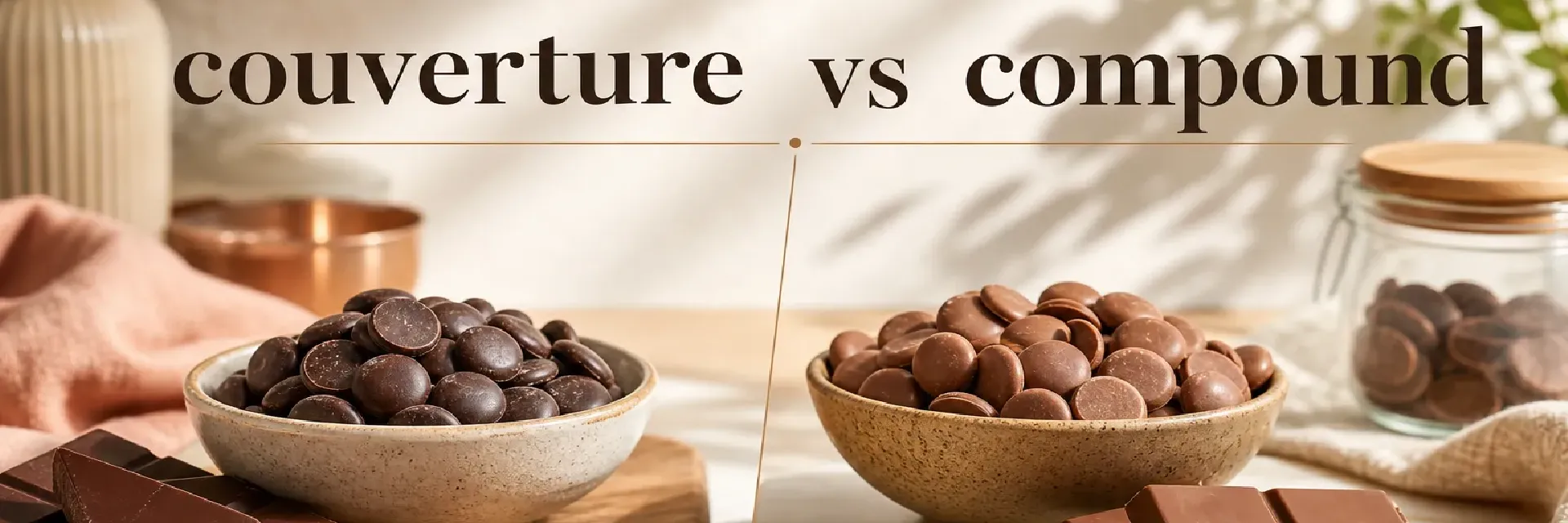
Think about cutting into a ganache cake at a birthday in Trivandrum. Sometimes the chocolate melts the instant it meets your tongue, clean and rich and satisfying. Other times there is a faint waxy film that lingers on the palate, something slightly off but hard to name. That difference, more often than not, traces back to one decision made before anything went into the oven: which chocolate was used. If you have ever wondered about couverture vs compound chocolate for baking, that moment of tasting is exactly where the answer lives.
Many bakers in Kerala have both types sitting in their pantry without fully knowing when to reach for which. Couverture and compound chocolate look similar and smell broadly similar, and in a pinch, one might seem like a fair substitute for the other to the casual observer. But they are built from different fats, they behave differently in the kitchen, and they produce noticeably different results in the things that matter most: flavour, texture, and finish.
At Bread Factory by Azad, the type of ingredient that goes into a product is never an afterthought. That applies to chocolate too, where the choice between cocoa butter and vegetable fat shapes everything from the way a ganache pours to the way a truffle melts. This article covers the composition of each type, how they behave when you actually work with them, which one suits which task, and where to find them if you are baking in Trivandrum or anywhere across Kerala.
Couverture vs compound chocolate for baking: what separates them
The fat at the centre of the difference
Couverture chocolate is built around cocoa butter, the natural fat extracted from cacao beans. Under FSSAI regulations in India, couverture must contain at least 31% cocoa butter and at least 35% total dry cocoa solids. The ingredient base is cocoa mass, cocoa butter, and sugar, with milk solids added for milk and white varieties. In many premium couvertures, the fat is exclusively cocoa butter, sourced entirely from the cacao plant itself.
Compound chocolate takes a different path. Cocoa butter is replaced by vegetable fats: commonly palm kernel oil, coconut oil, hydrogenated palm oil, or blends of these. The cocoa solids in compound typically come from cocoa powder rather than cocoa mass, cocoa liquor, or a combination of both. There is no minimum cocoa butter requirement. The result is a product that looks like chocolate and tastes broadly similar to it, but is not compositionally the same thing.
What this means for flavour and mouthfeel
Cocoa butter has a melting point just below body temperature, which is why well-made chocolate dissolves almost the moment it touches your tongue. Vegetable fats have a different melting profile, tending to remain solid at a slightly higher temperature, which is why compound can leave a faint waxy or coating sensation on the palate. It is not unpleasant when compound is used for the right purpose, but it is noticeable when compared directly with couverture.
Flavour depth differs too. Cocoa mass carries complex aromatic compounds that cocoa powder does not fully replicate. This is why couverture tastes more rounded and layered, while compound often reads flatter and sweeter. Understanding this sensory difference is the foundation for every decision that follows in this article.
How each chocolate behaves in the kitchen
Tempering: when you need it and when you don’t
Couverture must be tempered. Tempering is the process of melting chocolate, cooling it to a specific temperature, then gently rewarming it to a narrow working range. This aligns the cocoa butter crystals into a stable form that gives you gloss, snap, and a clean set. Without it, couverture sets dull and soft, with a streaky or powdery finish that no one wants on a celebration cake.
For dark couverture, the standard curve is: melt to 50, 55°C, cool to 28, 29°C, then bring back to 31, 32°C for working. The seeding method is the most practical approach for small-batch bakers at home or in a small bakery. Melt two-thirds of your chocolate, then stir in the remaining third finely chopped until the temperature drops into the working range. A thermometer is not a luxury here; it is the whole point.
Compound requires no tempering at all. Melt it, use it, and it will set on its own with a decent finish. This single difference makes compound far more accessible for bakers who are not yet comfortable with the tempering process, or for situations where speed and volume matter more than precision of finish.
Working time, melting, and forgiveness
Couverture is temperature-sensitive in ways that genuinely matter in a Kerala kitchen. If the room is too warm, it loses temper quickly and sets soft. If the bowl cools unevenly, it thickens and becomes difficult to work with. In Trivandrum’s heat and humidity, this is a real and constant challenge. Working couverture properly here usually means an air-conditioned room, active cooling support, and a thermometer at every stage. Avoid moving chocolate rapidly between cold and warm environments: condensation on the surface is one of the most common causes of sugar bloom and dull finishes.
Compound is far more forgiving. It can be held warm, re-melted without consequence, and applied across a wider working window without the risk of falling out of temper. Neither type is better in absolute terms; they are built for different jobs. But if you are working in an open kitchen in May without cooling, that practical difference is significant.
Which chocolate suits which baking task
When couverture is worth the effort
Ganache is where couverture consistently earns its higher price. The cocoa butter integrates cleanly with cream to produce a silky, well-emulsified texture that is smooth to pipe and satisfying to eat. Anyone who has compared the two side by side will notice that couverture ganache feels more structured and pipeable, while compound versions tend to be slightly softer and less refined in their finish. For a dark chocolate tart, for truffle centres, for the ganache layer on a birthday or anniversary cake, couverture is the right choice.
Moulded pieces also depend on couverture for the result most bakers are aiming for. Properly tempered couverture releases cleanly from moulds with a gloss that compound cannot replicate. If you are making chocolates for an Onam gifting box or a celebratory chocolate assortment, the visual and textural difference is clear. One important rule: do not mix couverture and compound in the same batch. The incompatible fats can disrupt how the mixture sets and create unpredictable results.
When compound is the practical choice
For decorative chocolate work, quick coatings, and high-volume drizzling, compound is genuinely the more practical tool. A bakery producing large daily batches of chocolate-drizzled biscuits, enrobed snacks, or coated pastries does not need the precision of tempering on every run. Compound’s no-fuss handling is a real operational advantage at that scale.
For home bakers doing a quick after-school snack in Trivandrum or a last-minute topping on a cake, compound is a reasonable and accessible starting point. The honest truth is that compound is not a shortcut when it is used for the right job. It only falls short when it is used as a substitute for couverture in tasks where the taste and texture of the chocolate itself are what the recipe is built around.
The ingredient question every baker should ask
Ingredient choices reflect baking values
Every time a baker reaches for an ingredient, they are making a decision about what the final product will be. The choice between cocoa butter and vegetable fat is exactly that kind of decision. It is not just about cost or convenience; it is about what you believe the food should do when it reaches someone.
At Bread Factory by Azad, this thinking runs through everything the bakery makes. Choosing butter over margarine in breads, baking fresh every day without preservatives, avoiding artificial colours, these reflect ingredient decisions made quietly and consistently, because the food you put in front of people reflects how much you respect them. The question of couverture vs compound chocolate for baking lives in exactly the same space. The type of chocolate you choose says something about the kind of baker you are.
What ingredient integrity means in practice
For home bakers, this does not mean compound is wrong or that couverture is the only acceptable choice. It means understanding what you are choosing and why. When chocolate is the hero of a dish, a truffle centre or a ganache filling for a festive table, the ingredient decision carries real weight. When it is a decorative drizzle or a quick coating on something where another flavour leads, compound earns its place without apology.
Thoughtful baking is not about using the most expensive ingredient on every occasion. It is about understanding the role each ingredient plays and choosing it with that clarity. That is a
Compound chocolate and where it makes sense
Compound chocolate is widely stocked at local baking supply shops across Trivandrum and Kerala.Here is a simple working rule for you to follow: if the chocolate is the hero of the dish, invest in couverture. If it is background or functional work, compound does the job well at a fraction of the cost. For home bakers in Trivandrum managing a modest baking budget, compound is a realistic and sensible starting point for coating and decorating work. Couverture is where you invest when the flavour of the chocolate itself is what you are asking someone to taste and remember.
Choosing with intention
This is not a verdict about which chocolate is better in all situations. Both couverture and compound have genuine, legitimate roles in a working kitchen. The distinction is about intention: knowing what each one does, understanding where it belongs, and choosing with that clarity rather than defaulting to whatever is nearest or cheapest.
When it comes to couverture vs compound chocolate for baking: use couverture for flavour-led work, and compound for practical volume tasks. And always ask what the ingredient is actually doing in this recipe before reaching for it. That question, applied consistently, is what separates food that is merely edible from food that people remember.
At Bread Factory, the same principle that guides every other ingredient decision guides the chocolate used in desserts and celebration cakes: choose what best serves the finished product. It is a straightforward standard, and one that shows in the eating.
Order Bread Factory’s fresh bakes to your doorstep
If reading about ingredient choices has made you curious about what thoughtful baking actually tastes like, you do not have to go far. Every product at Bread Factory is made fresh in-house daily, without preservatives or artificial colours, using clean ingredients chosen for the right reasons. Download the Bread Factory app to browse our full range of freshly baked breads, celebration cakes, cookies, desserts, and more, delivered directly to your doorstep in Trivandrum.
Download for Android: Get the app on Google Play
Download for iOS: Get the app on the Apple Store