
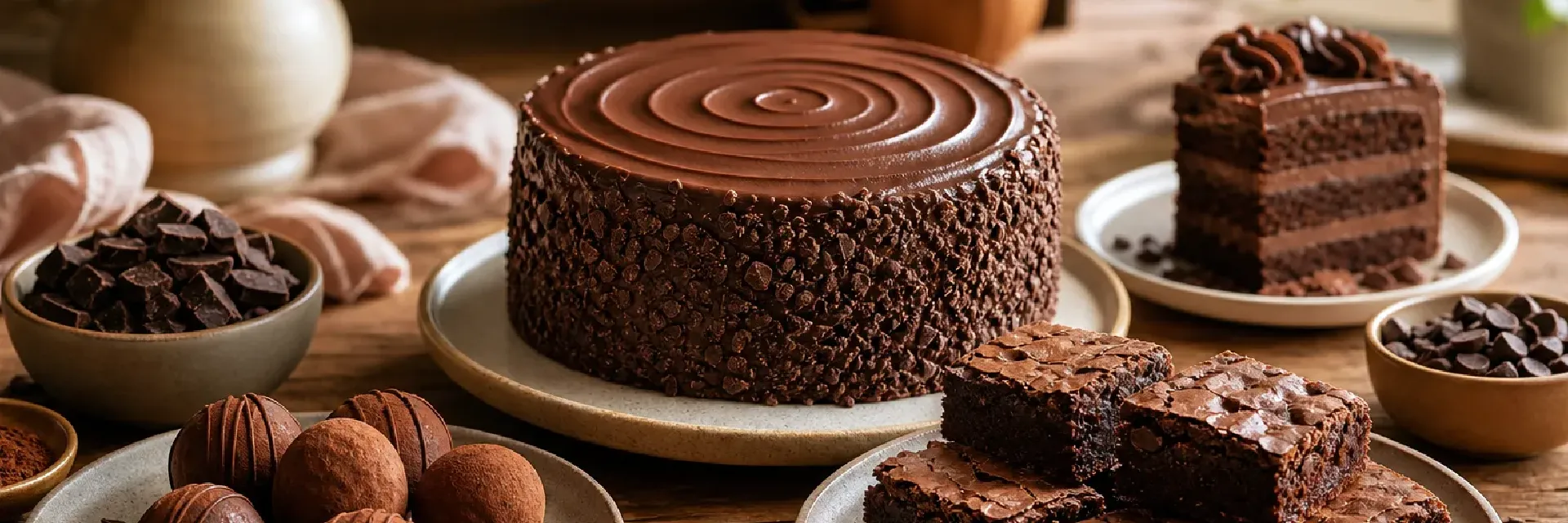
Walk into any bakery in Trivandrum in the morning and you will see why bakery chocolate desserts stop people in their tracks. Watch what happens at the display counter: people pause, lean in, slow down. Almost every time, it is the chocolate section that does it, the deep, cocoa-rich smell of ganache, a row of truffle-coated cakes, or a tray of freshly baked brownies still warm from the oven. There is something about a well-made chocolate dessert that simply demands attention.
What is interesting is how consistent that pull is across ages, occasions, and seasons. At many bakeries in Trivandrum, chocolate desserts attract steady footfall year-round, not just for birthdays or special celebrations, but as part of the everyday rhythm of bakery life: an after-school brownie, a chocolate pastry on the way home from work, a whole truffle cake ordered for no particular reason other than wanting one.
But not all bakery chocolate desserts are equal, and most customers sense this even if they cannot name exactly why. One truffle cake feels rich and satisfying; another feels sweet but hollow. A brownie can be dense and fudgy, or it can be dry and deeply disappointing. The difference almost always comes down to what went into it and how carefully it was made. At Bread Factory in Trivandrum, this has been the central question for years: not just how to make chocolate desserts, but how to make them the right way. This guide covers the most popular bakery chocolate desserts among Kerala bakery-goers, what makes each one genuinely special, and what to look for when you want the real thing.
The bakery chocolate desserts Trivandrum customers order most
If you look at what bakeries in Trivandrum and across Kerala stock every single day, a clear pattern emerges. Chocolate cake formats dominate, with the truffle cake leading by a wide margin. After that come brownies and chocolate pastries, ordered reliably as weekday snacks and evening treats. Mousse-style cakes, chocolate chip cookies, and cheesecake variants form the next tier: growing, consistent, but not yet at the volume of the classics.
This is not a trend driven by social media. Kerala has always had a strong bakery culture, and chocolate desserts fit naturally into it. The demand here is not seasonal the way it might be in cooler cities. People order chocolate cakes in June during the monsoon just as readily as they do in December. That consistency is what makes chocolate bakes the backbone of any serious Trivandrum bakery’s daily menu.
The truffle cake and why it still leads the list
The chocolate truffle cake is among the most-ordered bakery chocolate desserts in India, a position it has held for some time, according to major bakery sellers and aggregated ordering data. The reason is not complicated: it delivers on two levels simultaneously. You get a soft, moist chocolate sponge and a rich, smooth ganache coating that feels genuinely indulgent without being heavy. That combination is hard to argue with.
In Kerala, the truffle cake has become practically inseparable from birthday culture. Walk into any birthday party in Nalanchira or Kowdiar and there is a very good chance you will see one on the table. Bakeries that bake fresh in-house stock truffle cakes daily because the demand never really dips. The format works for a small slice on a Tuesday and a full cake for a celebration on a Sunday, which is exactly why it leads the list.
Brownies, pastries, and the everyday chocolate order
Brownies and chocolate pastries occupy a different but equally important position. These are the weekday orders, the after-work stops, the “I just want something small and chocolatey” purchases. They are lower-commitment than a full cake but still deeply satisfying when done well. Bakeries that get these right build a loyal daily customer base almost by default.
The single-serve chocolate pastry, in particular, is one of those quietly iconic Indian bakery items. It has been around for decades, it has not changed much, and people keep ordering it. Cookies and mousse-style desserts are growing in popularity, especially among younger customers, but the brownie and chocolate pastry remain the dependable anchors of everyday chocolate bakery demand in Trivandrum.
What makes a chocolate truffle cake genuinely good
This is where most bakery chocolate desserts are either won or lost. A truffle cake can look perfectly acceptable and still be forgettable. The quality lives in two places: the ganache and the sponge underneath it. Get both right and you have something people will come back for. Get either one wrong and the whole thing falls apart, regardless of how it looks.
The ganache: where quality is most visible
A good ganache is glossy, smooth, and has a clean, forward chocolate flavour that lingers after the bite. It should melt evenly on the tongue without leaving a residue. When you cut through it, the texture should be consistent all the way through, not grainy on the surface and soft underneath.
The biggest factor here is the chocolate itself. Ganache made with real chocolate, which contains cocoa butter, behaves very differently from ganache made with compound chocolate, which uses vegetable fat instead. Real chocolate ganache melts smoothly and gives you that clean, genuine cocoa finish. Compound-based ganache tends to feel slightly waxy and leaves a coating on the palate. Many people report this sensation without knowing why it is there, the ganache that feels a bit heavy, the truffle coating that does not quite melt, the chocolate cream that clings a little too long. These are almost always the signs of compound rather than real chocolate at work.
The cream-to-chocolate ratio also matters significantly. A ganache with too much cream sets poorly and can taste thin. One with too little cream is stiff and dense in a way that feels laboured rather than rich. Bakeries that rush this step, or adjust ratios based on cost rather than quality, produce a ganache that feels greasy or grainy. You can taste the shortcut.
The sponge underneath matters just as much
A truffle cake is only as good as the base it sits on. The sponge needs to be moist enough to contrast with the ganache, structured enough to hold its shape when cut, and flavoured well enough to contribute to the overall taste rather than just act as a filler layer. A dry sponge, a gummy centre, or a floury aftertaste undermines the entire dessert.
The most common signs of a poorly baked base are dry edges that crumble when sliced, a dense crumb that sits heavily rather than melting, or a slightly raw centre with a doughy quality. These are almost always the result of overbaking, incorrect ratios, or baking the sponge in advance and holding it before assembly. A bakery that bakes fresh in-house every day has a structural advantage here. The sponge goes from oven to assembly to the customer’s table without a long hold time. That freshness shows in every bite.
Brownies, chocolate pastries, and what sets them apart
Brownies and chocolate pastries look straightforward, but both have quality markers that most customers can feel even if they have never thought about them explicitly. These are not complicated desserts. That simplicity is exactly why the difference between a good one and an average one is so obvious.
The brownie: fudgy versus cakey and why it matters
The fudgy versus cakey debate is one that most brownie lovers have a clear position on, even if they have never framed it that way. For most people who order brownies regularly, the preference is for a dense, fudgy centre with a slightly crisp top crust. That combination of textures is what makes a brownie feel indulgent rather than just another baked square.
Fudginess comes from three things: the fat ratio, the baking time, and the quality of the chocolate or cocoa used. More fat relative to flour, a slightly shorter bake, and good-quality cocoa or melted chocolate all move a brownie toward fudgy rather than cakey. The most common bakery shortcut that produces a dry, disappointing brownie is overbaking, followed closely by poor-quality cocoa powder. Using butter rather than margarine is a common bakery practice to achieve the richer flavour and denser mouthfeel that most customers expect from a proper bakery brownie.
The chocolate pastry: an underrated daily-order item
The single-serve chocolate pastry is one of Trivandrum’s most consistent everyday bakery orders and it deserves more credit than it gets. At its best, it is a small, carefully assembled thing: light chocolate sponge, smooth chocolate cream, a clean finish that feels satisfying without being heavy. It is the kind of item people order almost automatically, and when it is done right, they do not question why they keep coming back.
The difference between a fresh pastry and one that has sat overnight is immediately obvious. Fresh cream is light and has a clean dairy flavour; cream that has been sitting becomes slightly dense and can taste flat. The sponge in a fresh pastry has give and moisture; a day-old one feels compressed and dry at the edges. The cross-section of a well-made pastry looks clean and neat. A poor one looks uneven and slightly collapsed. Mousse-filled pastry formats, a category of no-bake chocolate treats assembled rather than baked, take this a step further in terms of texture and richness, but even the classic chocolate pastry, done properly, is a genuinely satisfying thing.
What makes the best bakery chocolate desserts: the ingredients behind the difference
Most customers never see the ingredient decisions that go into a bakery chocolate dessert. They only taste the result. But those decisions are everything: the type of chocolate, the kind of sugar, whether artificial colours are used. Understanding these choices helps you recognise quality when you find it.
Real chocolate versus compound: what it means in practice
Compound chocolate is made with vegetable fat instead of cocoa butter. It is cheaper, easier to work with, and does not require tempering. That is why it is used by many mid-range bakeries in India, particularly for coatings, truffle finishes, and chocolate decorations. Couverture chocolate, made with cocoa butter, is more expensive and more demanding to work with, but the difference in taste is not subtle.
Real chocolate melts at body temperature. You eat a piece of real chocolate ganache and it dissolves cleanly, leaving a clear cocoa flavour behind. Compound chocolate, because it uses vegetable fat, melts less cleanly and often leaves a waxy residue on the palate. That slightly coated feeling after eating a chocolate dessert is usually compound at work. The ganache that feels a bit heavy, the truffle coating that does not quite melt, the chocolate cream that clings a little too long, these are almost always compound rather than real chocolate.
The decisions customers rarely see: sugar, colour, and what they add
Artificial colouring and compound coatings are commonly used in mid-range bakery chocolate desserts, and both are often visually detectable. Artificial colours are used to make truffle coatings look darker, chocolate pastry cream look richer, and decorations look more vivid. The visual sign is often an overly uniform, almost too-dark or too-glossy finish that lacks the natural variation you see in real cocoa-based products. The flavour sign is a slight flatness or chemical edge underneath the sweetness.
On the sugar side, refined sugar is the standard across most bakeries. Some bakeries have quietly moved to low-GI sugar in their cakes, which digests more slowly and reduces the glycaemic load without meaningfully changing the flavour or texture for most customers. It is a small but considered decision, and one that health-conscious families in Kerala increasingly appreciate. At Bread Factory in Trivandrum, the brand’s stated commitment is to honest baking methods: no artificial colours, low-GI sugar in cakes, butter in place of margarine, and no shortcuts on the chocolate. These are choices that most customers will never read on a label but will always taste in the result.
How to tell a genuinely good bakery chocolate dessert from a forgettable one
Armed with the knowledge above, you can make much better choices at any bakery counter. There are a few quick, practical checks that tell you a great deal before you even take a bite.
What to notice before you buy
Start with the colour. A genuine chocolate dessert has a deep, natural brown that comes from real cocoa. An overly black, unnaturally vivid, or strangely glossy finish often points to artificial colouring or a compound coating rather than real chocolate. Look at the surface of a ganache cake: a good ganache catches the light in a natural way, with slight variation. A compound coating tends to have a more uniform, plastic-like sheen.
The smell is another reliable signal. Good bakery-style chocolate desserts have a warm, genuine cocoa note, slightly earthy, slightly sweet, unmistakably chocolate. A stale or poorly made dessert has a flat smell, or sometimes a faint sour undertone from old cream. Finally, ask when it was baked. A bakery that bakes in-house every day should answer that question clearly and confidently. If the answer is vague or evasive, that tells you something important.
Storing chocolate desserts in a Kerala kitchen
Kerala’s humidity and heat are genuinely challenging for chocolate desserts. The warmth softens ganache and cream, and the moisture accelerates bloom on chocolate surfaces and speeds up staling. What might last comfortably on a kitchen counter in Delhi for two to three days will deteriorate much faster in a Trivandrum kitchen, especially during the monsoon months.
- Brownies: Store in an airtight container.Plain brownies can last two to three days at room temperature if your kitchen is cool, but refrigerate sooner if there is any dairy topping or if the weather is humid.
- Ganache truffle cakes and mousse pastries: Refrigerate promptly after purchase. Consume within one to three days for mousse-based formats, and withinthree to five daysfor ganache cakes, depending on the specific product. Bring to room temperature for ten to fifteen minutes before eating for the best texture and flavour.
- Dense chocolate fudge and confections: These keep longer because of their high sugar content. Store in an airtight box in a cool, dry spot, with parchment between layers if stacked.
The practical rule for Kerala kitchens is simple: when in doubt, refrigerate. Quality drops faster in warm, humid conditions than most people expect, and the difference between a fresh chocolate dessert and one that has been left out too long in Kerala heat is not subtle.
A more considered chocolate choice
A great bakery chocolate dessert is not about an elaborate presentation or a high price point. It is about what went into it: the quality of the chocolate, the freshness of the sponge, the care in the ganache, the decision not to use artificial colours or cheap vegetable fat coatings. These things are invisible on the surface but completely clear in the eating.
Kerala customers have long shown a preference for locally baked, daily-made food over packaged alternatives, an instinct reflected in how neighbourhood bakeries here operate and how customers choose between them. Those instincts are worth listening to when you are standing at a bakery counter deciding between one chocolate truffle cake and another. Asking when something was baked, or what fat was used in the brownie, is not fussiness. It is the kind of considered choice that leads to a noticeably better result.
At Bread Factory in Trivandrum, the everyday operating principle has been the same for years, freshly baked every day, real ingredients, no artificial colours, no margarine, no shortcuts. It shows in the ganache. It shows in the brownie. It shows in every bakery chocolate dessert that leaves the kitchen. If you would like to explore the full range, the easiest way is through the Bread Factory app, where you can browse everything and have it delivered directly to your door.
Download for Android:Google Play Store
Download for iOS:Apple App Store