
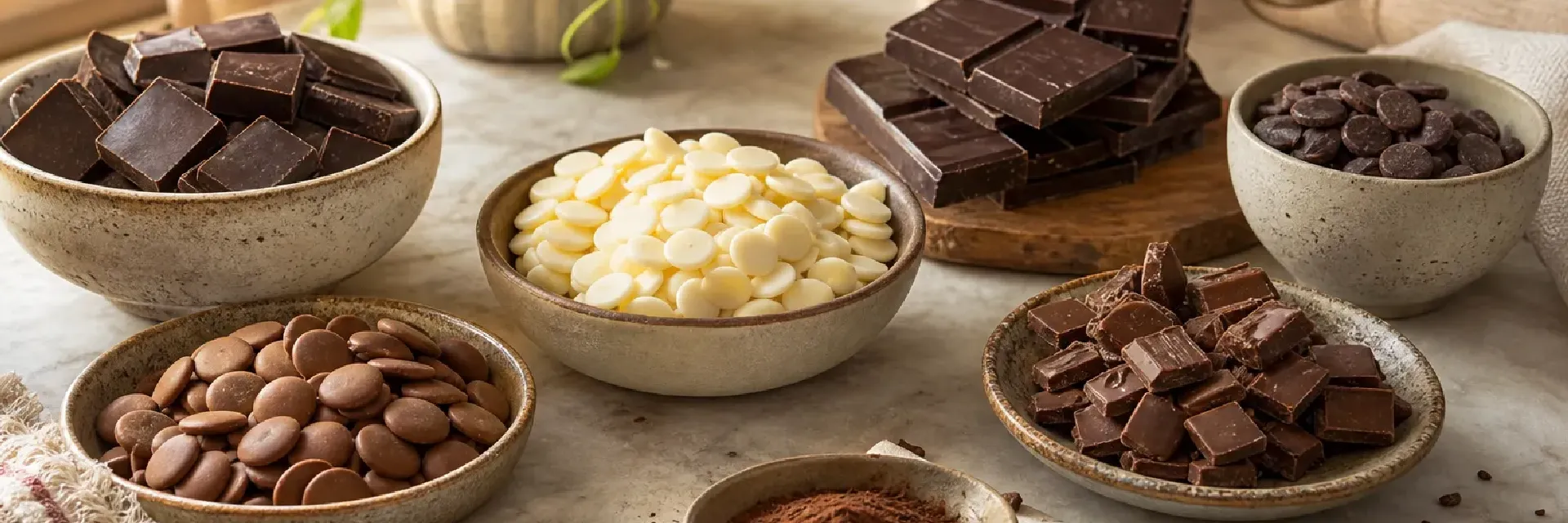
You are halfway through a recipe, the kitchen smells like butter and anticipation, and the instructions say “dark baking chocolate.” Three packets sit on the supermarket shelf in front of you: one labelled compound, one labelled couverture, one simply labelled dark chocolate. Not one of them carries a useful explanation on the back. If you have ever baked at home in Kerala, this guide to the types of chocolate for baking in India will give you the answers those packets never did, which type to reach for, what the numbers on the label mean, and where to source quality chocolate here.
The bakery culture in Kerala is deep and genuine. Baked goods, fresh puffs, tea cakes, celebration cakes, have long been part of everyday life here, and at Bread Factory (Azad Bread Factory) in Trivandrum, that tradition is taken seriously. The type of chocolate that goes into a ganache filling, a celebration cake, or a dessert cut is chosen with purpose, because the wrong choice changes the flavour and texture in ways that skill alone cannot fix. The same principle applies when you bake at home.
The main types of chocolate for baking in India, and what separates them
One distinction is worth landing before everything else: compound chocolate replaces cocoa butter with vegetable fat, while every other type uses cocoa butter as its primary fat. That single difference explains most of the variation you will encounter in flavour, texture, and price. Once you understand it, reading packaging becomes much simpler.
Dark chocolate: from unsweetened to bittersweet
Dark chocolate in a baking context covers a range. At one end is unsweetened chocolate, which is essentially pure cocoa mass with no added sugar. It is rarely used on its own; it belongs in recipes that are already adding sugar separately. At the other end is bittersweet chocolate, which has some sugar added, a richer flavour, and a more balanced bitterness. This is what most Indian recipes mean when they say “dark chocolate,” and it typically falls in the 55 to 70% cocoa range.
If a recipe does not specify further, bittersweet is the safe choice. It melts smoothly, blends well into batters, and gives a deep chocolate flavour without overwhelming the other ingredients.
Milk and white chocolate
Milk chocolate adds one extra ingredient to the dark chocolate formula: milk solids. This makes it sweeter, softer in texture, and more delicate under heat. It behaves differently from dark chocolate in the oven, setting softer and melting faster, so it needs more careful handling. White chocolate takes a different path entirely. It contains cocoa butter, sugar, and milk solids, but no cocoa solids at all, which is why it has no real chocolate flavour as such, only creaminess and sweetness. It is not a substitute for dark chocolate in most recipes; it is an ingredient in its own right.
Both milk and white chocolate are more heat-sensitive than dark chocolate. In a warm Kerala kitchen, this matters. Overheating either type even briefly can cause it to seize or turn grainy before it ever reaches the bowl.
Compound chocolate: the practical truth
Compound chocolate uses vegetable fat instead of cocoa butter. This makes it cheaper, faster to melt, easier to set at room temperature, and far more forgiving in tropical conditions. It does not require tempering, which makes it accessible for everyday use. These are real advantages, and they explain why compound chocolate is so widely used across Indian home kitchens and commercial bakeries.
The honest trade-off is that compound cannot replicate the flavour depth or mouthfeel of real chocolate. For a quick coating, a garnish, or a drizzle, it works perfectly well. For a ganache filling or a celebration cake where chocolate is the centrepiece, the difference is noticeable. FSSAI regulations in India require that products containing vegetable fat in addition to cocoa butter declare this clearly on the label, so you can always tell from the packaging if you know where to look.
Couverture: the professional choice
Couverture is real chocolate with a higher proportion of cocoa butter than standard eating chocolate. This makes it fluid when melted, which is exactly what professionals need for dipping, moulding, and coating. The high cocoa butter content also gives it a characteristic snap and shine when tempered properly. At Bread Factory, couverture is the choice when the chocolate finish needs to be as good as the filling inside it.
Couverture does require tempering for glossy, snap-worthy results. This involves cycling the melted chocolate through specific temperature stages to stabilise the cocoa butter crystals. For home bakers who are new to chocolate work, it is not an everyday starting point. But it is the right choice when the finish genuinely matters.
What cocoa percentage actually means for your bake
The percentage on a chocolate label refers to the total cocoa content: both cocoa solids and cocoa butter combined. It is not a measure of cocoa solids alone. Two chocolates labelled at 70% can behave differently depending on the brand’s formulation, the ratio of cocoa butter to cocoa solids, and the emulsifiers used. This is why a recipe that worked with one brand may behave slightly differently with another at the same percentage. A higher percentage means more cocoa content and less sugar, generally producing a drier, more structured result in baking, because cocoa solids absorb moisture and add body, which delivers a richer, more intense flavour and a firmer, sometimes denser texture. Knowing this before you swap one baking chocolate for another mid-recipe saves a great deal of guesswork.
Choosing the right percentage for cakes, brownies, and ganache
For cakes, a 50 to 60% chocolate gives a softer, more tender crumb with a rounded chocolate flavour. Going above 70% can make the cake denser and drier unless the recipe compensates with extra fat or liquid. For brownies, 55 to 65% usually hits the fudgy, rich balance most people want. Higher percentages make brownies more intensely flavoured but risk a drier, firmer finish.
For ganache, lower percentages create a softer, sweeter result; 60 to 70% gives a more structured, chocolate-forward ganache that holds its shape better, which is useful for filling cakes. For coatings and shells, higher percentages snap better and taste less sweet. Match the percentage to what the recipe is asking the chocolate to do, not just to personal taste.
Why Kerala’s climate changes how you work with chocolate
Most baking guides are written for temperate kitchens. A kitchen in coastal Kerala during monsoon season is a fundamentally different environment, and it changes how chocolate behaves at every stage, from melting to setting. Understanding this removes a lot of frustration from the process.
How humidity affects melting and setting
Moisture in the air can cause chocolate to seize even without direct contact with water. Seizing happens when sugar particles absorb ambient moisture, clump together, and turn the melted chocolate thick and grainy. In high-humidity regions like coastal Kerala, particularly during the monsoon, this is a genuine concern rather than a theoretical one. Compound chocolate is more resistant because it sets faster and is less sensitive to ambient conditions, which is a plausible reason it became so common in Indian commercial kitchens over time.
Choosing between compound and couverture in a warm Indian kitchen
For everyday home baking in Kerala, compound chocolate is more practical for coatings, garnishes, and decorative work, particularly during summer and monsoon months. It sets reliably, does not require tempering, and is forgiving of small temperature fluctuations. Couverture becomes the better choice when flavour is the priority: for a ganache filling in a celebration cake, for a rich chocolate dessert, or for anything where chocolate is the main event. For couverture work at home, an air-conditioned kitchen makes a significant practical difference in the outcome.
Simple storage rules for the Indian climate
Store chocolate in an airtight container, away from direct sunlight and moisture. In Kerala, refrigerating chocolate requires care. When chocolate comes back to room temperature from the fridge, condensation forms on the surface and causes sugar bloom, a pale, chalky film that signals moisture damage. Store chocolate in a cool, dry spot at a consistent temperature rather than the refrigerator if possible. A closed cupboard away from the stove works better than most fridges in this climate.
How to melt and handle each type at home
Good chocolate handling is mostly about gentleness and dryness. The mistakes that cause chocolate to seize or turn grainy almost always come from too much heat or a small amount of moisture finding its way into the bowl. Both are avoidable with simple attention.
The double boiler method and microwave approach
A double boiler is a heatproof bowl set over a pot of barely simmering water, without the bowl touching the water. The gentle, indirect heat gives you more control and reduces the risk of scorching. The microwave works well in short 15 to 20 second bursts with stirring in between, stopping as soon as the chocolate is almost fully melted and letting the residual heat finish the job. The most important rule with both methods: keep every surface completely dry. Even a small amount of water in the bowl can seize the entire batch.
Temperature ranges for dark, milk, and white chocolate
Dark chocolate melts well below 50°C and should not be pushed much beyond that. Milk chocolate is more delicate; keep it below 45°C during melting, and ideally closer to 41, 43°C for best results. White chocolate is the most sensitive of the three, melt it gently and stop applying heat as soon as it begins to soften, letting the residual warmth do the rest.
Tempering, which involves cycling melted chocolate through specific temperature stages for a glossy finish and firm snap, is only necessary when you need moulded chocolates or dipped sweets to look and feel professional. For brownies, cakes, and ganache, simply melted chocolate is perfectly fine.
What to do if chocolate seizes or splits
If your chocolate seizes and turns grainy, adding a small amount of warm cream or neutral oil and stirring gently can sometimes bring it back to a workable consistency. It will not be suitable for tempering after that, but it can still go into a ganache or a batter. If a ganache splits and looks oily or broken, gentle rewarming and steady stirring usually fixes it. These are common situations; they happen to professional bakers regularly. Patience and gentle heat are the response, not panic.
Where to buy baking chocolate in India
Availability is a real challenge for home bakers outside metro cities. Many bakers outside metros rely on online suppliers for quality chocolate, as specialty baking stores can be sparse in smaller cities. The good news is that most of the brands worth using ship across India reliably.
A quick note on cooking chocolate and chocolate chips
You may also see products labelled as “cooking chocolate” on supermarket shelves, this term has no regulated definition in India and usually refers to a compound product. Treat it accordingly. Chocolate chips, meanwhile, are formulated to hold their shape in the oven, not to melt smoothly. They are fine stirred into cookies and muffins, where you want distinct chocolate pockets rather than a fully melted result. For ganache, coatings, or any recipe that needs fluid melted chocolate, a baking block or couverture callets will give you a much better outcome. Ganache made with chips can feel thick or slightly grainy compared to one made with a proper baking bar, and the difference shows in the finished product.
The right chocolate, chosen deliberately
The right type of baking chocolate for your recipe depends on the fat source, the cocoa percentage, and what your kitchen environment will actually allow, all three shift the outcome. For many home bakers in warm, humid kitchens across Kerala, a quality compound chocolate is often the most practical choice for day-to-day baking. It is forgiving, consistent, and widely available.
When chocolate is the centrepiece of a celebration cake, a truffle filling, or a dessert cut, the step up to real chocolate makes a difference that the person eating it will notice. This is the same thinking behind how Bread Factory by Azad approaches every product in its range: no shortcuts, no guesswork, just the right ingredient chosen deliberately. Understanding the types of chocolate for baking in India, and what each one actually does in a recipe, is what separates a good bake from a great one.
Order fresh from Bread Factory
Everything at Bread Factory is baked fresh in-house daily, with clean ingredients and no shortcuts. From celebration cakes and dessert cuts to cookies, pastries, and more, you can browse the full range and have it delivered directly to your doorstep across Trivandrum.
Download the Bread Factory app to explore everything freshly baked and made without shortcuts.
Download for Android: Google Play Store
Download for iOS: Apple App Store