
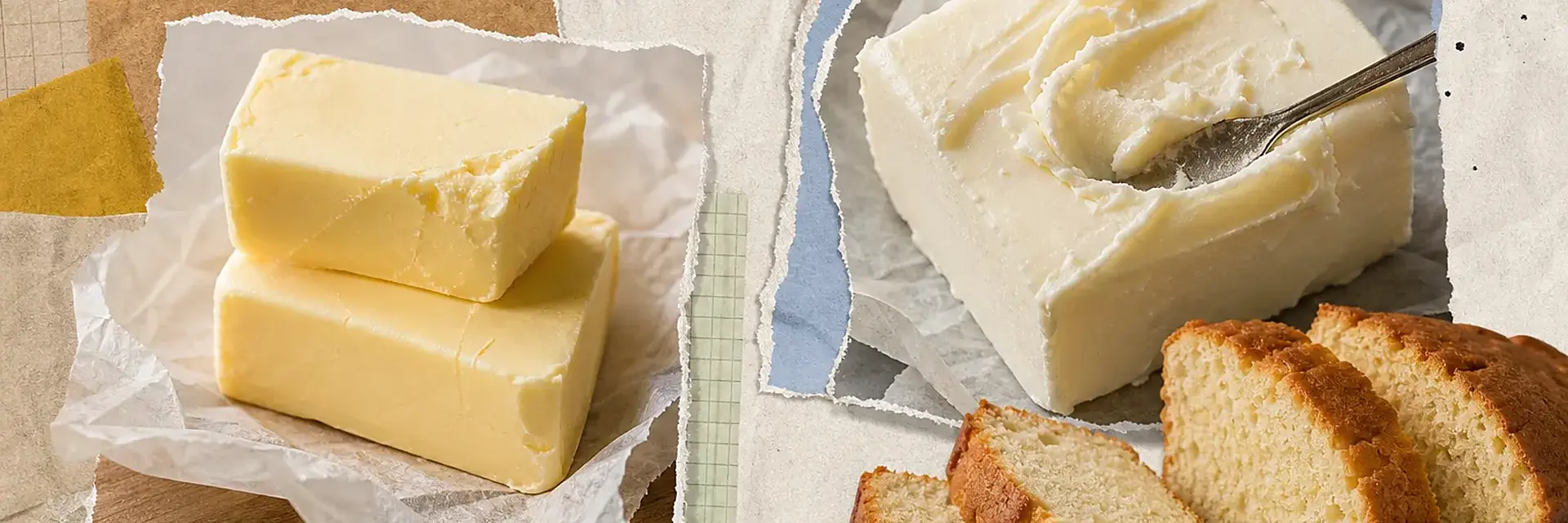
When it comes to vanaspati vs butter in baking, the fat inside a loaf or biscuit changes far more than most people realise. Vanaspati does not announce itself on the front of your bread packet or biscuit tin. Instead, it hides behind words like “vegetable fat,” “shortening,” or “partially hydrogenated oil” in the ingredients list. It is widely used across many Indian commercial bakeries because it is cheap, stable at tropical temperatures, and easy to work with at scale. This article is not a scare piece. It is a practical, honest comparison of two very different baking fats: how they perform in the oven, what they do to flavour, and what they mean for your family’s health over time.
The fat inside a loaf of bread or a batch of cookies is one of the most consequential ingredient decisions a baker makes. It shapes texture, drives flavour, affects shelf life, and says something about what the baker believes families deserve on their table. Understanding the difference between vanaspati and butter gives you the tools to read labels intelligently and ask better questions of your local bakery.
What vanaspati actually is, and how it became India’s default bakery fat
Vanaspati, sold under brand names like Dalda or described as vegetable ghee on packaging, is made by passing hydrogen gas through liquid vegetable oil under pressure and heat. This process, called hydrogenation, converts a liquid fat into a semi-solid with a higher melting point, giving it the spreadable, ghee-like consistency it is known for at room temperature. Commercial vanaspati is typically semi-solid at room temperature; reported melting/slip-melting points vary by formulation and region, often around 31–40°C, while Indian market samples in one study showed 54–67% solid fat at 20°C.. That high solidity at room temperature is precisely what makes it useful in a bakery: it is predictable, firm, and easy to handle without refrigeration.
The problem is that hydrogenation also creates industrial trans fatty acids as a by-product of that solidification process. These are not the same as the naturally occurring trans fats found in small amounts in dairy. Industrial trans fats in vanaspati are the variety that health science has consistently identified as harmful, and they are the central health concern with this fat. Beyond chemistry, vanaspati became a widely used bakery fat across India for straightforward commercial reasons: it is substantially cheaper than butter, it has a significantly longer shelf life because it contains almost no water or dairy solids that can go rancid, and it is shelf-stable at Indian ambient temperatures. From the mid-20th century onward, it was actively marketed as a modern substitute for ghee, embedding itself across the food industry in a way that persists today.
Vanaspati vs butter in baking: oven performance and texture
Unsalted butter is approximately 80 to 82% fat, 16 to 18% water, and 2 to 3% milk solids consisting of proteins and natural sugars. None of these components are incidental. The water content turns to steam during baking, creating expansion in the batter and contributing to a lighter, more open crumb. The milk solids undergo the Maillard reaction in the heat of the oven, producing the golden colour and roasted, nutty aroma that makes a butter cake smell the way it does. Butter softens at typical room temperatures and melts around 32 to 35°C, meaning its fat crystals are smaller and more varied than vanaspati’s at typical baking temperatures.
These structural differences translate directly into baking performance. When you cream butter and sugar together, butter’s plastic fat crystals trap air efficiently, producing a light, well-aerated batter. Vanaspati can do this too, but with less efficiency, resulting in a slightly heavier batter and a more compact finished crumb. Butter’s built-in moisture also means that butter-enriched breads stay softer for longer after baking, whereas vanaspati-based breads tend toward a drier crumb over time. None of this means vanaspati fails in the oven. It does the job. But “does the job” and “does it well” are not the same thing.
Cookies and biscuits
In cookies and biscuits, the differences are noticeable even to an untrained palate. Vanaspati, being a hydrogenated shortening with high solid fat content, typically causes less spread in cookies, producing thicker, harder biscuits with a more uniform shape. For flaky biscuits and pastry layers, that high solidity at cool temperatures actually works in vanaspati’s favour, creating distinct, crisp layers. This functional quality helps explain why hydrogenated fat is so common in commercially produced Indian biscuits. Butter cookies behave differently: they spread a little more in the oven, develop a richer brown colour at the edges, and deliver that characteristic crisp-outside, tender-centre texture that comes from butter’s fat and water working together during baking.
Cakes
In cakes, the water content in butter directly supports leavening. As the batter heats, that moisture becomes steam, helping the cake rise and setting a finer, more open crumb structure. Replace butter with vanaspati, which contains essentially no water, and the bake typically produces a denser, more compact result unless the recipe is adjusted with additional liquid.
Laminated doughs
For laminated doughs like puff pastry, butter gives visible, defined layers with a clean separation; vanaspati gives flakiness, but without the same clarity of lift. The difference is structural, and it comes from the fat’s composition rather than from technique. Comparing vanaspati and butter for baking laminated doughs makes this contrast especially clear. For more on how different fats behave in layered and flaky products, see our guide to types of bread.
Flavour: why butter-baked goods taste the way they do
Vanaspati has a bland, neutral, and faintly waxy flavour profile on its own. It does not contribute meaningfully to the taste of a finished bake. Many commercial vanaspati formulations compensate for this by including added artificial butter flavour and yellow colouring to simulate the sensory experience of ghee or butter. When you eat a commercial biscuit that tastes almost buttery but somehow flat or one-dimensional, that artificial flavouring is often the reason, reflecting added butter flavouring rather than natural dairy complexity. The flavour deficit is the product of a functional shortcut, not a minor variation.
Butter works differently because of chemistry, not engineering. Its dairy solids caramelise in the oven, producing diacetyl and a range of other flavour compounds that create the complex, warm, roasted aroma of freshly baked goods. These compounds are difficult to fully replicate with artificial flavouring; the chemistry of natural dairy fat in a hot oven is irreducible. Available industry and sensory evidence generally indicates that butter and ghee are preferred over vanaspati for flavour, with vanaspati’s commercial value being functional and economic rather than sensory. If you have ever noticed that a fresh cake from a principled bakery tastes noticeably richer than its mass-produced equivalent, the fat used is almost always the explanation.
Vanaspati vs butter in baking: health, trans fats, and FSSAI limits
Historically, vanaspati in India could contain extremely high levels of industrial trans fats. FSSAI has noted that TFA levels in vanaspati could be as high as 50–60% of total fat content, while WHO reports that partially hydrogenated oils typically contain 25–45% trans fat. Industrial trans fats raise LDL cholesterol, lower HDL cholesterol, promote inflammation, and are strongly linked to cardiovascular disease. Harvard’s Nutrition Source cites the well-known estimate that every 2% increase in daily calories from trans fat is associated with about a 23% higher risk of coronary heart disease.
FSSAI has made genuine progress. From January 2022, oils, fats and food products using edible oils/fats are subject to a 2% trans-fat limit, a major tightening from earlier higher limits. However, “FSSAI compliant” is not the same as literally “trans-fat-free.” Under FSSAI rules, a food can claim “trans fat free” if it contains less than 0.2 g trans fat per 100 g/100 ml, while edible oils/fats can make the claim below 1 g per 100 g/100 ml. Butter does not contain industrial trans fats from partial hydrogenation, but it can contain naturally occurring ruminant trans fats.
Knowing what to look for on a label matters. Vanaspati appears under several names in ingredients lists:
- Vegetable fat or vegetable shortening
- Hydrogenated vegetable oil
- Partially hydrogenated vegetable oil
- Edible vegetable oil (refined and hydrogenated)
If any of these appear in the first three or four ingredients of a packaged biscuit, bread, or cookie, the product is very likely to contain vanaspati-derived fat. Reading past the front of the pack takes thirty seconds and gives you far more accurate information than any front-of-pack claim.
Practical swap ratios, and the choice that defines a bakery’s character
For home bakers who need to substitute one fat for another, the starting ratios are straightforward. Vanaspati and butter swap 1:1 by weight, but since vanaspati contains no water, your bake will be slightly drier. Add a small amount of milk to compensate, start with around 1 to 2% extra liquid and adjust by feel. If you are substituting ghee for butter, use approximately 80 g of ghee per 100 g of butter; ghee is clarified butter with the water removed, so its absence will affect lift in cakes and you should add a small measure of water or milk to compensate. For oil as a butter substitute, use approximately 80 g of oil per 100 g of butter; this works well for moist cakes but will not produce the same crumb structure or flavour depth.
For flaky pastry and laminated doughs, no substitute truly matches butter. The layering behaviour, the flavour, and the texture that come from butter’s specific fat crystal structure are the hardest things to replicate with any other fat. This is not perfectionism. It is physics and chemistry behaving exactly as they should.
Which brings the conversation back to the bakery. In an industry where vanaspati is a common default because it cuts costs and survives India’s ambient temperatures without refrigeration, choosing to bake exclusively with butter is a deliberate, expensive decision. At Bread Factory in Thiruvananthapuram, that is precisely the commitment they have made: the outlets bake fresh each day with no preservatives and no shortcuts on ingredients. The outlets across Nalanchira, Vazhuthacaud, Kumarapuram, and Kowdiar bake fresh each day with no preservatives and no shortcuts on ingredients. Butter costs more, requires careful handling, and shortens shelf life compared with a hydrogenated fat. Accepting all of that is not a marketing position. It is a values statement about what families in Kerala deserve to eat every morning. Thoughtfully made with you in mind.
The fat in your bread is worth knowing about
Weighing up vanaspati vs butter in baking ultimately comes down to three interconnected questions: what you want from texture and crumb, what you expect from flavour, and what you are willing to accept on the health front. Butter produces a lighter crumb, better lift, and superior lamination because of its water content and fat crystal structure. Its dairy compounds caramelise naturally in the oven, producing a richness that artificial flavouring struggles to fully match. And unlike vanaspati, butter carries no industrial trans fats, a meaningful distinction even after FSSAI’s welcome 2022 reforms.
The practical steps from here are straightforward. Read ingredients lists rather than front-of-pack claims. Ask your bakery what fat it uses in its bread and pastries. Bear in mind that “vegetable fat” in an ingredients list is not a neutral or healthy descriptor; it is a category that historically has included some of the most harmful fats in the food supply. A bakery that absorbs the higher cost of real butter every day, for every product, is telling you something important about how it sees its responsibility to the people it feeds. The fat inside a loaf of bread is quiet, invisible, and consequential. It deserves more attention than it typically gets.
Have everything Bread Factory sells delivered directly to your doorstep. Download our app to browse our full range of clean, freshly baked goodness.
Download for Android on Google Play
Download for iOS on the Apple Store