
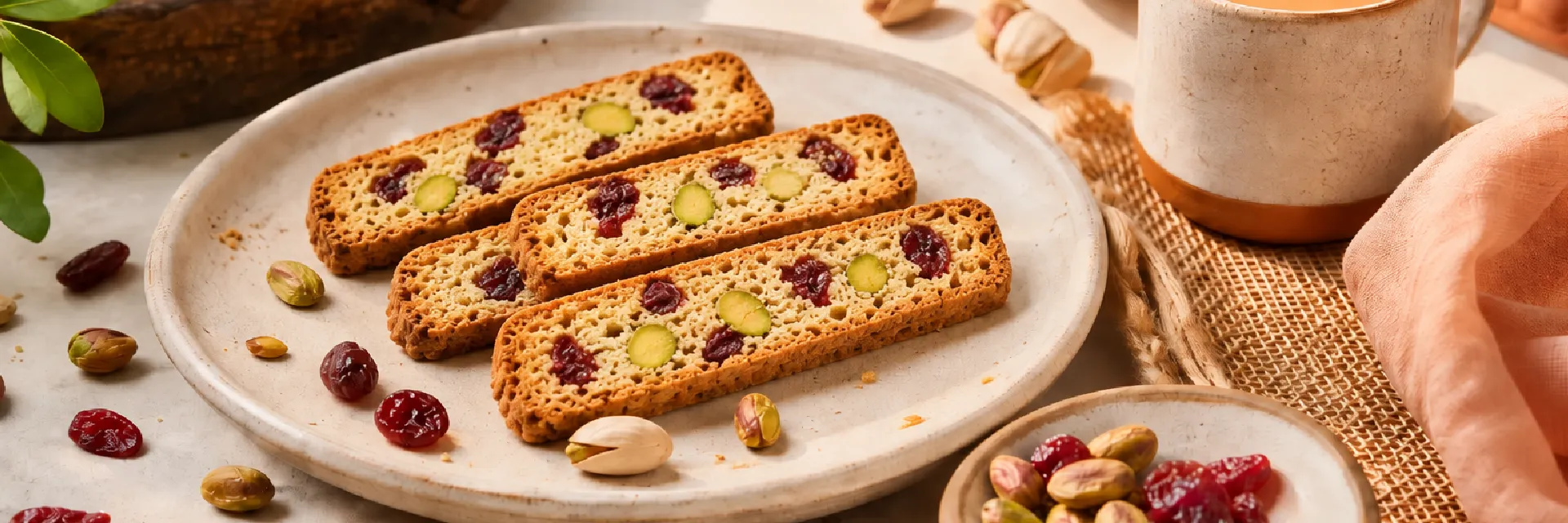
Cranberry pistachio biscotti in India is steadily finding its way into conversations about the perfect accompaniment to a serious cup. Whether it is a strong filter coffee poured into a stainless steel tumbler or a ginger-laced masala chai warming your hands after a long day, the question that follows is always the same: what do I eat with this? A plain biscuit works. A rusk does the job. But once you have tried a well-made cranberry pistachio biscotti alongside that cup, everything else starts to feel a little ordinary.
This biscotti has been appearing at some cafés and bakeries in Trivandrum over the last few years, quietly and without much fanfare. The flavour makes immediate sense to anyone who tries it: tart dried cranberries, a good pistachio crunch, a dry texture that holds up perfectly when dunked. It is the kind of biscuit that rewards a little curiosity. And it is the kind of product that a bakery committed to clean ingredients and no shortcuts, like Bread Factory, gets genuinely right.
Here is everything worth knowing before you seek it out, from its Italian origins to where to buy cranberry pistachio biscotti in India today.
Where this biscotti actually comes from
The Italian tradition of twice-baked biscuits
Biscotti comes from the Latin biscoctus, meaning “twice-cooked.” The technique is exactly what it sounds like: the dough is shaped into a log, baked once, sliced, and then baked again to dry out completely. The result is a biscuit with almost no moisture, deliberately so. This is not a shortcut or an accident. It is a method developed over centuries, originally to create a food that could survive long journeys without spoiling.
The low moisture content is the key to biscotti’s extended shelf life. A properly made, preservative-free biscotti typically keeps for one to two weeks at room temperature, because there is very little left for bacteria or mould to act on. That said, commercially sealed varieties often rely on additional additives and moisture-barrier packaging to stretch shelf life to several months, which is worth keeping in mind when reading a label.
How cranberry and pistachio became the pairing
The classic Italian biscotti used almonds, and many traditionalists still prefer it that way. But as Italian baking moved across Europe and into international café culture, bakers began experimenting with other combinations. Dried cranberries brought tartness and a striking ruby colour. Pistachios brought a grassy, slightly sweet richness that almonds alone could not offer. The pairing caught on first in American and European artisan bakeries, then travelled steadily into Indian café culture. Today, cranberry pistachio biscotti in India appears in online listings and across boutique bakeries in cities from Mumbai to Thiruvananthapuram, and the interest shows no sign of fading.
Why this flavour works so well with chai and filter coffee
The tart-nutty balance that cuts through warmth
The flavour logic here is straightforward once you understand it. South Indian filter coffee is rich, slightly bitter, and full-bodied. The tartness of dried cranberry provides a contrast that lifts the palate, cutting through that heaviness in the same way a squeeze of lemon lifts a heavy dish. Pistachio, meanwhile, echoes the nutty caramel undertones already present in the coffee, making the combination feel rounded rather than jarring. With masala chai, the spice notes from cardamom and ginger find a counterpoint in the fruit-acid bite of cranberry, while pistachio softens the overall impression and adds a creamy depth beside the black tea base.
Kerala’s tea culture and the search for the right accompaniment
Hot drinks are a central part of daily life for many in Kerala. Coffee and chai are not afterthoughts; they are daily rituals with proper time set aside for them. Rusks and plain biscuits have traditionally held the accompaniment role, but cranberry pistachio biscotti offers something more layered without being unfamiliar. The crunchy texture still satisfies the instinct to dip and bite. The flavours are distinct but not exotic. For anyone in Trivandrum who has grown up dunking Marie biscuits into tea and wants something a little more interesting, this is a natural next step.
What separates a well-made biscotti from a mediocre one
The ingredient question most buyers skip
A proper biscotti has a short, honest ingredient list: good flour, real butter, sugar, eggs (or an eggless equivalent), dried cranberries, and whole pistachios. That is essentially it. The twice-baked process does much of the preservative work naturally, so a well-made biscotti needs minimal added chemistry to hold its crunch. The problem with many commercially packaged versions is that they use margarine or vegetable shortening instead of butter, flavoured cranberry pieces instead of real dried fruit, and a list of additives, including emulsifiers, artificial colours, BHA, BHT, and sodium benzoate, that are common across packaged biscuit products in India. Biscotti is not exempt from these practices. Reading the label before buying matters more than most people realise.
Why the absence of shortcuts matters in the long run
When biscotti is made with real butter, whole dried cranberries, and actual pistachios, the difference is noticeable in the eating. The crunch is cleaner. The aftertaste is lighter. The fruit and nut flavours come through without a synthetic edge. A biscotti made without shortcuts holds up properly when dunked rather than collapsing or leaving an oily film in the cup. This is not about being precious or artisanal for its own sake. It is about the basic integrity of a product made the way it was supposed to be made. A bakery that holds this standard across its breads, cakes, and savouries applies the same discipline to its biscotti.
Why a local, clean-ingredient bakery is the better answer for Trivandrum
For families in Trivandrum, the more meaningful question is not which e-commerce platform ships biscotti fastest. It is whether there is a bakery close by that bakes it the right way, using real butter and no artificial additives, and holding freshness as a non-negotiable. Bread Factory is exactly that kind of place. The philosophy behind every loaf of bread, every celebration cake, and every cookie on the shelf applies equally to the biscotti: clean ingredients, honest methods, no shortcuts. When cranberry pistachio biscotti is made in that spirit, it is a fundamentally different product from what arrives in a sealed commercial packet. Buying from a local bakery you trust is always the better answer.
A biscuit worth coming back to
Cranberry pistachio biscotti has earned its place at the Indian tea table through sound flavour logic, not novelty. Its Italian roots are centuries deep. The twice-baked method is inherently practical. And when it is made without preservatives, without margarine, and without the chemical scaffolding that props up most commercial versions, it earns its place on any Trivandrum tea table, next to a cup of filter coffee or a warm glass of chai.
At Bread Factory, Thoughtful Baking is not a tagline. It is the daily discipline behind every product on the shelf. The same care that goes into the breads and celebration cakes goes into the biscotti: clean ingredients, real butter, no shortcuts, baked fresh. That is the standard, and it does not change.
If you are in Trivandrum, Bread Factory makes it straightforward. Browse the full range of freshly baked, preservative-free biscotti and other clean bakes, and have them delivered directly to your doorstep. Download the Bread Factory app to place your order.
Have everything Bread Factory sells delivered directly to your doorstep.
Download our app to browse our full range of clean, freshly baked goodness.
Download for Android on Google Play
Download for iOS on the Apple Store