
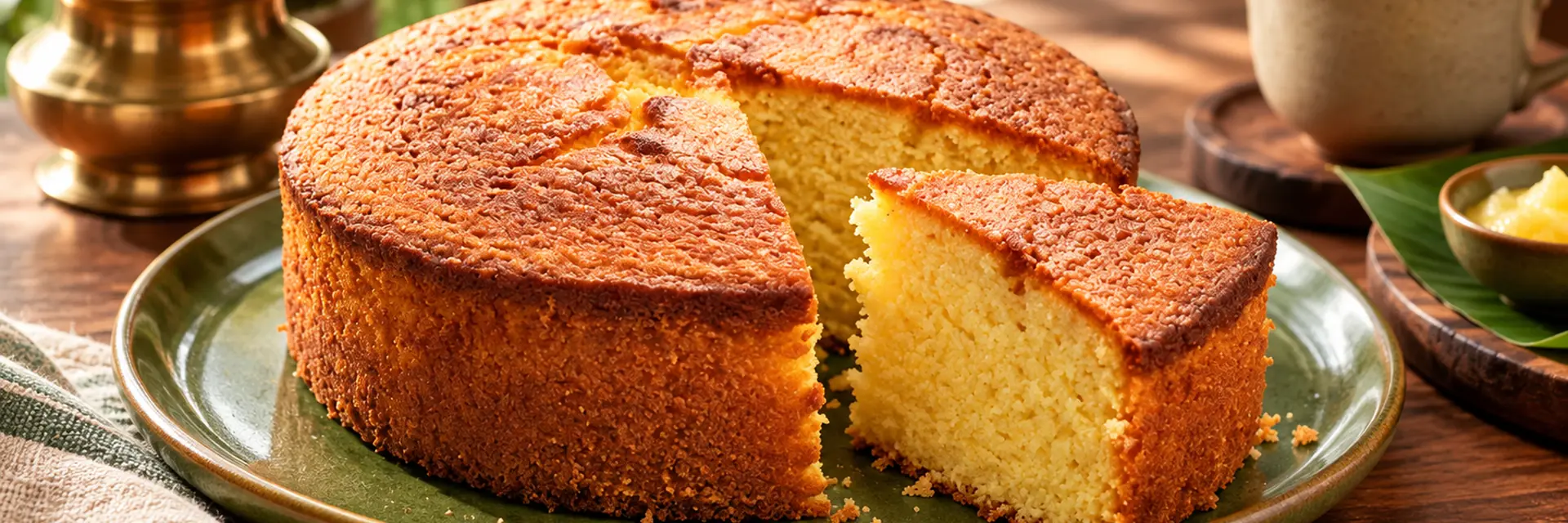
Kerala’s traditional ghee cake announces itself before you even open the oven door. That particular smell, warm, faintly nutty, with the unmistakable depth that only real ghee carries through a hot oven, belongs to Kerala kitchens in a way that is difficult to explain to anyone who did not grow up inside one. If you were raised in a household in Thiruvananthapuram, Kochi, or anywhere between the two, you know this smell. It needs no introduction and no occasion to feel right.
The traditional ghee cake in Kerala, known locally as neyy cake , is one of those rare bakes that has never needed reinventing. It was not designed for a trend. It was not adapted from a foreign recipe to suit local tastes. It simply arrived, took root, and stayed. Generations later, it remains one of the most requested cakes at bakeries across the state.
At Bread Factory in Trivandrum, the Indian ghee cake (as it appears on the menu) is baked fresh every day, with real ghee and real milk. Real ghee, real milk. No shortcuts, no substitutes. But before talking about what makes a bakery-made ghee cake worth seeking out, it helps to understand why ghee was always at the heart of this tradition in the first place.
Ghee’s place at the centre of Kerala’s baking tradition
Why ghee was never just a cooking ingredient in Kerala
In Kerala kitchens, ghee has always carried a different kind of weight. It was the fat of celebration, the finishing touch on a festive spread, the ingredient that signalled care. When you smelled ghee in a neighbour’s kitchen, you knew something significant was being prepared. This elevated status translated naturally into baking as the region’s bakery culture grew, shaped over centuries by Syrian Christian, Malabar Muslim, and colonial British influences.
This differs considerably from North Indian baking traditions, where butter and dalda were far more common. In Kerala, ghee was already present in every significant meal and ritual, local, familiar, and trusted. Choosing it for celebration cakes was not a deliberate creative decision; it was simply the ingredient that made sense.
How Kerala’s regional bakeries shaped the ghee cake
Bakeries in Trivandrum and the Malabar belt each developed their own version of the Kerala ghee cake, but both stayed loyal to real ghee as the defining ingredient. This was never about nostalgia. It was about flavour. The roasted, nutty aroma of ghee in a baked sponge is something no other fat quite replicates. Butter brings freshness and creaminess; vanaspati brings neutral richness. Ghee brings depth, warmth, and a flavour that lingers in the crumb long after the cake cools.
What makes a traditional ghee cake in Kerala taste and feel different
The aroma that tells you before the first bite
A freshly baked Kerala ghee cake announces itself. The smell coming out of the oven is warm, slightly nutty, faintly caramelised, with an edge of vanilla. This is not the neutral sweetness of a plain sponge. This is a cake that has a personality, and it makes itself known before you have even cut into it.
This aroma comes from the way ghee behaves in the oven. Unlike butter, ghee has already had its milk solids removed during clarification. When it bakes, it develops deep, roasted notes that butter simply cannot match. Some traditional versions, particularly in the Malabar style, deepen this further by gently heating the ghee, a method sometimes called kaachifying, until the milk solids just begin to brown before it is incorporated into the batter. The result is an intensely fragrant, almost confectionery richness. Certain regional versions also use a touch of cardamom or lemon zest, which adds a subtle brightness against the ghee’s warmth.
A texture built for Kerala’s taste
The Kerala ghee cake is not a light chiffon or an airy soufflé. The crumb is dense, moist, and tender; it holds together when you cut it but melts cleanly when you eat it. This texture is no accident. Traditional Kerala bakers work with a considered ratio: roughly equal weights of flour, ghee, and sugar, supported by eggs and milk. This is a formula that has been passed down and trusted precisely because it works.
Compared to a standard butter sponge, the ghee version has more depth of flavour and a slightly firmer, more satisfying bite. The absence of water in ghee, which butter contains in significant amounts, contributes to a denser, more flavourful crumb. It is the kind of cake that improves your afternoon rather than simply filling it.
Ghee cake across Kerala’s festive calendar and daily rituals
When celebrations call for a ghee cake
Walk through the occasions where a ghee cake naturally appears in Kerala and you cover almost every important moment in the year. Onam gift boxes, Christmas spreads in Christian households, Eid celebrations in Malabar families, birthday tables across all communities. This cake does not belong to one religion or one region. It belongs to the idea of celebration itself.
The golden crust and familiar aroma carry an immediate quality signal. When you bring a ghee cake to a relative’s home, or serve it at a family gathering, it communicates something without words. It says that care was taken. People notice this, and they remember it.
Why it became a tea-time staple in Kerala
Kerala has one of the strongest chai and bakery cultures in the country. The evening tea break is close to sacred in most households, and the ghee cake fits this ritual with quiet ease. Unlike cream-heavy pastries or overly sweet desserts, a slice of ghee cake with black chai or milky tea is satisfying without being excessive. The richness of the ghee balances the bitterness of the tea in a way that feels almost deliberate.
This daily-snacking appeal is also why the rice ghee cake, a lighter and simpler variation found across central Kerala, found its own loyal audience. Not everyone wants the full richness of the classic version every afternoon. But even in its simpler form, the cake remains rooted in the same tradition: real ghee, clean ingredients, a bake that is honest about what it is.
Neyy cake, Trivandrum style: what the different names tell us
The many names for one beloved Kerala ghee cake
The Malabar ghee cake tends to lean richer and more aromatic, with the ghee flavour at the absolute forefront. The Trivandrum bakery-style version tends to have a lighter, airier crumb, closer to a classic bakery sponge while remaining distinctly ghee-forward. Despite these differences, a few things define every authentic version. The ghee must be real. The bake must be fresh. And the flavour must carry that unmistakable roasted warmth that no substitute can convincingly replicate.
What stays the same no matter where you eat it
Customers who eat ghee cake regularly know immediately when a substitute has been used. The aroma gives it away first. Vanaspati has no natural dairy scent, and even butter smells noticeably different from ghee in a hot oven. The texture follows. A cake made with real ghee has a particular quality to the crumb, a combination of density and moistness that margarine or vegetable fat cannot quite produce. The ingredient does not lie, and neither does the cake.
Where this tradition is kept alive in Trivandrum today
Why people still seek out a bakery-made ghee cake
There is a reason Trivandrum residents still walk into a bakery for their ghee cake rather than reaching for something packaged. A good ghee cake needs to be fresh. The aroma that defines it fades within a day or two, and the texture shifts when the cake sits too long. Freshness is not merely a quality marker for a ghee cake; it is a requirement. A shelf-stable product with stabilisers and preservatives simply cannot replicate what a bakery-made cake delivers on the day it is baked.
Bakery-made also means the ingredients can be verified. When a Kerala ghee cake is made with real milk and real ghee, with no artificial additives in the mix, the flavour reflects this honestly. At a bakery that makes its ghee cake daily, you can ask exactly what goes in. A packaged product rarely invites that question. There is nothing hidden in the crumb.
How Bread Factory honours this tradition
At Bread Factory in Trivandrum, the Indian ghee cake is baked fresh in-house every day. Real ghee, real milk. No shortcuts, no substitutes. This is what Thoughtful Baking means in practice: choosing the right ingredient, using it properly, and baking it fresh rather than preparing large batches and hoping the freshness holds.
The result is a cake that feels familiar to anyone who grew up with a traditional ghee cake in Kerala. The roasted warmth of ghee in every bite, a moist crumb that holds together, and that characteristic golden crust. It fits equally on a birthday table, in an Onam gift box, or beside an evening cup of tea. Available across Bread Factory’s outlets in Nalanchira, Vazhuthacaud, Kumarapuram, and Kowdiar, and through the Bread Factory app for home delivery across Trivandrum.
A tradition that earns its place every single time
The traditional ghee cake in Kerala has survived generations not because it was fashionable, but because it was honest. Real fat, clean flavour, baked with care and served fresh. That is not a complicated formula, but it requires discipline to maintain every single day.
In a time when most packaged bakery products carry a long list of preservatives and stabilisers, a Kerala ghee cake made the traditional way feels like a quiet act of respect: for the ingredient, for the tradition, and for the people eating it. Some things do not need to be updated. They just need to be done properly.
Bread Factory is a Trivandrum bakery that takes this seriously. Come in and try it for yourself, or have it delivered to your door. A slice of the ghee cake will tell you everything this tradition has been saying for generations.
Get your ghee cake delivered fresh
Have everything Bread Factory bakes delivered directly to your doorstep. Browse Bread Factory’s full range of freshly baked products, including the Indian ghee cake, through the Bread Factory app.
Download for Android on Google Play: Bread Factory – Apps on Google Play
Download for iOS on the Apple Store: Bread Factory – Apps on Apple Store